
AI Enterprise Applications: Popular Use Cases and Industry Examples to Build a Powerful AI Infrastructure Foundation
Blog / AI Enterprise Applications: Popular Use Cases and Industry Examples to Build a Powerful AI Infrastructure Foundation
As AI technologies and tools continue to evolve at an unprecedented pace, limiting AI to a single department or using it only for basic tasks is no longer sufficient to meet modern business demands. Today, enterprise AI adoption is not merely about improving individual productivity—it is about aligning AI with business objectives, optimizing workflows, enhancing decision-making, and driving service innovation.
This article explores key AI application areas and industry use cases to help organizations identify the most effective starting point for their digital transformation journey.
Why Should Enterprises Adopt AI? The Key to Efficiency and Operational Transformation
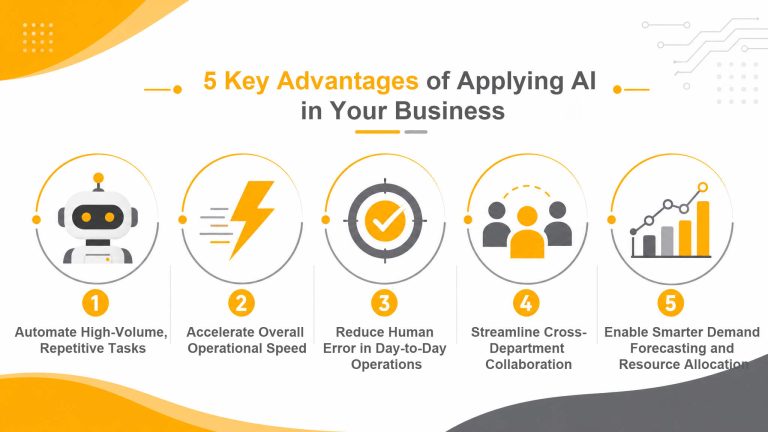
For many organizations, the value of AI extends beyond automating repetitive tasks. AI enables businesses to respond faster to market changes, improve resource utilization, and establish more competitive operating models.
Key benefits of enterprise AI applications include:
- Automating repetitive tasks: Data entry, document classification, customer inquiries, report generation, and routine review processes can all be automated, reducing manual effort.
- Improving execution speed: AI accelerates information processing, content generation, data retrieval, and response workflows, enabling faster internal operations and customer service.
- Reducing human errors: In data-intensive and repetitive tasks, human mistakes are difficult to eliminate entirely. AI helps minimize data entry errors, misclassifications, and workflow omissions through consistent rule-based execution.
- Enhancing cross-department collaboration: AI applications extend beyond IT support to customer service, operations, administration, and sales, facilitating smoother information flow and reducing communication overhead.
- Supporting forecasting and resource optimization: By analyzing historical and real-time data, AI helps predict sales trends, inventory requirements, customer demand, and service workloads, enabling more agile resource allocation.
Five Popular AI Application Areas
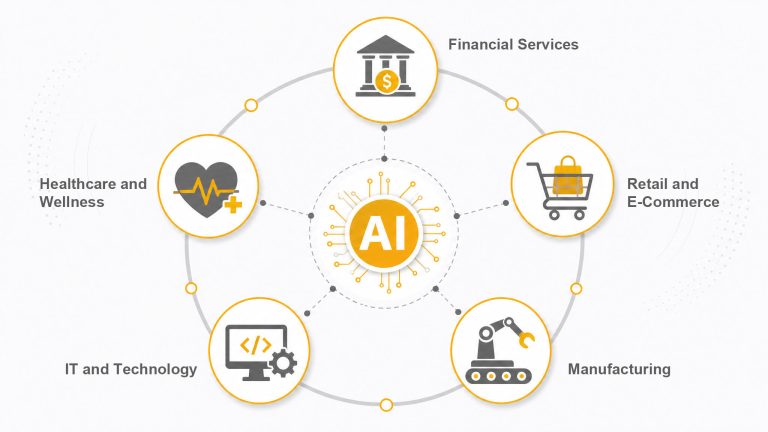
Before embarking on digital transformation initiatives, organizations should first understand how AI is being applied across industries. Examining real-world use cases helps identify integration opportunities and infrastructure requirements.
1. Financial Services
The financial sector has long prioritized data processing efficiency, risk management, and customer experience, making it one of the earliest adopters of AI technologies.
For banks, insurance companies, securities firms, and financial institutions, AI supports both customer-facing services and backend operations, including:
- Intelligent customer service and virtual assistants
- Risk assessment and fraud detection
- Customer segmentation and personalized recommendations
- Reporting analytics and regulatory compliance support
2. Retail and E-Commerce
Retailers and e-commerce businesses manage large volumes of customer interactions, product information, and rapidly changing market demand, making AI a valuable tool for improving efficiency and decision-making.
Common applications include:
- Product recommendation engines and personalized marketing
- AI-powered customer service and shopping assistants
- Marketing content generation
- Inventory forecasting and sales analytics
3. Healthcare and Life Sciences
Healthcare organizations increasingly leverage AI to process complex information, analyze medical images, and automate administrative tasks, reducing workloads for healthcare professionals and administrative staff.
Examples include:
- Medical imaging assistance and diagnostics support
- Medical record summarization and documentation
- Appointment scheduling and intelligent patient inquiries
- Health data analytics and risk prediction
4. IT and Technology
The IT and technology sector demands high levels of system reliability and operational efficiency, leading to deeper AI integration across technical workflows and infrastructure management.
Common use cases include:
- Software development and coding assistance
- Internal technical knowledge assistants
- Log analysis and anomaly detection
- Technical documentation and project information management
5. Manufacturing
Manufacturing environments require high levels of precision, consistency, and operational efficiency. AI adoption typically focuses on quality control, equipment monitoring, production optimization, and automation.
Examples include:
- Defect detection and quality inspection
- Equipment monitoring and predictive maintenance
- Production line monitoring and scheduling optimization
- Process automation and operational management
Challenges Enterprises Face When Implementing AI
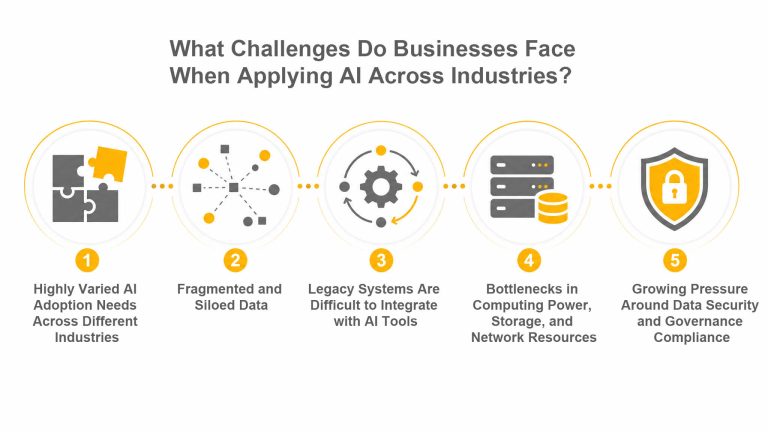
Although AI adoption continues to expand across industries, many organizations struggle to move from experimentation to successful implementation.
1. Diverse Industry Requirements
Different industries have unique operating models, regulatory requirements, data structures, and business priorities.
For example:
- Financial institutions prioritize risk management and fraud detection.
- Retailers focus on recommendation systems, customer analytics, and marketing automation.
- Healthcare organizations require strict data security and accuracy standards.
Without clearly identifying which business processes, departments, or pain points AI is intended to address, organizations may encounter fragmented tool selection, duplicated investments, and unclear implementation priorities.
2. Data Fragmentation
Data quality remains the foundation of every successful AI initiative.
Many organizations discover that customer data, operational information, and historical records are distributed across multiple systems such as CRM platforms, ERP systems, spreadsheets, customer service databases, and e-commerce platforms.
Without proper integration and data cleansing, even the most advanced AI models may struggle to deliver meaningful and reliable results.
3. Difficulty Integrating Existing Systems
Organizations often find that existing ERP, CRM, database, and internal business systems were not designed to work seamlessly with modern AI tools.
For example:
- An AI chatbot unable to access order, membership, or after-sales information will provide limited customer support.
- Analytics platforms unable to retrieve financial, operational, or inventory data may generate inaccurate forecasts.
4. Infrastructure Constraints
As organizations scale AI initiatives from pilot projects to enterprise-wide deployments, infrastructure limitations often become a major obstacle.
Applications involving large-scale data processing, AI inference, real-time responses, or concurrent usage across departments may experience performance bottlenecks due to insufficient computing power, storage capacity, or network bandwidth.
5. Security and Governance Challenges
AI implementation extends beyond deployment. Organizations must establish ongoing governance frameworks covering security, access control, compliance, monitoring, and risk management.
This is particularly important when handling customer data, business-sensitive information, internal documents, or confidential intellectual property.
Four Critical Factors Before Scaling AI Adoption
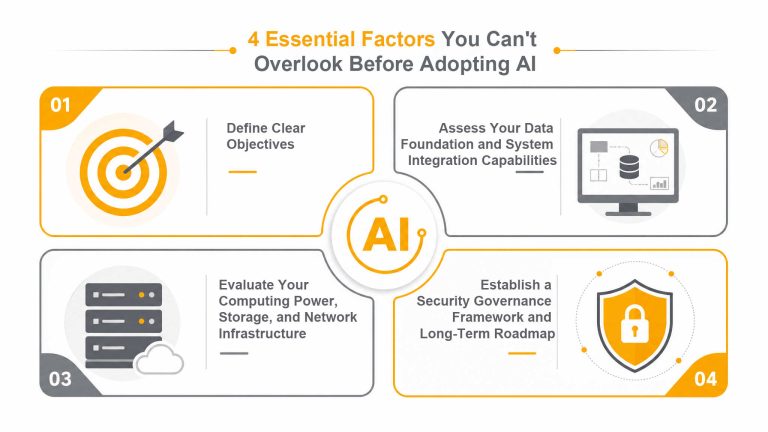
Successful AI implementation requires more than selecting the right use case. Organizations must also prepare the necessary data, systems, infrastructure, and governance capabilities.
1. Define Clear Objectives
Start with specific business goals, such as:
- Improving customer service response times
- Reducing document processing workloads
- Enhancing cross-department collaboration
- Accelerating data analysis and reporting
Clear objectives help prevent fragmented investments and unclear implementation priorities.
2. Assess Data Readiness and Integration Capabilities
Before deployment, organizations should evaluate:
- Existing data sources
- Data quality and completeness
- Integration capabilities between platforms, databases, and AI solutions
Establishing a reliable data foundation is essential for achieving meaningful AI outcomes.
3. Evaluate Computing, Storage, and Network Requirements
Organizations should distinguish between pilot-stage and production-stage resource requirements, estimate expected workloads, and plan for future scalability.
Flexible infrastructure models can help avoid overinvestment while ensuring sufficient resources for growth.
4. Establish Security Governance and Long-Term Management Plans
AI success depends on sustainable management practices.
Organizations should define:
- Which datasets AI systems may access
- Which departments may use AI tools
- Audit and logging requirements
- Ongoing monitoring, maintenance, and update responsibilities
A robust governance framework helps ensure secure and responsible AI adoption.
Scale AI Successfully with OneAsia
As demonstrated by the industry examples above, successful AI adoption depends not only on identifying suitable use cases but also on having the right data foundation, systems architecture, computing resources, and governance framework in place.
As AI initiatives expand from isolated projects to organization-wide deployments, a comprehensive long-term strategy becomes essential for transforming AI into a sustainable business capability.
OneAsia’s ITaaS (IT as a Service) solutions provide flexible access to the IT resources and support organizations need to accelerate AI adoption. By delivering infrastructure and services on demand, businesses can reduce upfront capital investments, maintain operational flexibility, and effectively address the resource and management challenges associated with AI deployment across different industries.
Contact OneAsia today to build a strong foundation for your AI-driven transformation.
References:
- NIST – Artificial Intelligence Risk Management Framework (AI RMF 1.0)
- European Commission – Apply AI Strategy
- OECD – The Adoption of Artificial Intelligence in Firms