
What Should You Consider When Choosing AI Compute Power Leasing? Understanding Cloud Compute Rental Models and Gaining High-Performance Computing Advantages
Blog / What Should You Consider When Choosing AI Compute Power Leasing? Understanding Cloud Compute Rental Models and Gaining High-Performance Computing Advantages

With the explosive growth of generative AI (Generative AI) such as ChatGPT and Gemini, enterprise demand for high-performance computing resources is increasing at an unprecedented pace. Across many industries, this has become a core consideration in IT investment and AI strategy planning.
This article takes an in-depth look at how cloud compute power rental models work, how enterprises should evaluate AI compute leasing providers, and how this approach can help businesses gain a competitive edge in the AI race.
Why Are Enterprises Turning to AI Compute Power Leasing? Breaking Through the GPU Supply Shortage
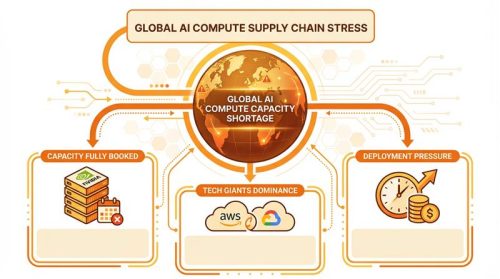
In the processes of AI model training and inference, “compute power” has become one of the three critical pillars alongside data and algorithms. However, the global market is currently facing a significant shortage of compute capacity:
- Capacity Fully Booked: Leading chip manufacturer NVIDIA’s next-generation Blackwell high-end AI GPUs have been confirmed to be almost completely sold out in terms of production capacity through the end of 2025. [2]
- Dominance by Tech Giants: Computing resources are primarily locked in by major technology companies such as AWS, Google, Microsoft, Meta, Amazon, and Oracle through large-scale advance orders. [2]
- Deployment Pressure: Most enterprises are facing longer delivery lead times and higher costs in 2025, with high-end GPUs remaining in a state of persistent undersupply in the short term. [2]
Against this backdrop, AI compute power leasing has emerged as the preferred solution for enterprises. By adopting a “rent instead of buy” approach, organizations can alleviate the financial pressure of hardware procurement while avoiding lengthy hardware delivery cycles. This allows AI projects to be launched immediately, ensuring that R&D timelines are not delayed by supply chain bottlenecks.
What Is Compute Power Leasing? Why Has Compute Power Rental Become the Mainstream Model for AI Development?
In simple terms, compute power leasing refers to enterprises or individuals paying cloud service providers or compute centers for access to computing resources, primarily GPU compute power, rather than purchasing physical servers themselves. This model, often described as “GPU as a Service” (GPUaaS), focuses on delivering raw computing capability and GPU memory bandwidth, and is specifically designed for deep learning training and inference workloads. [3]
Beyond addressing supply shortages, cloud-based compute power rental has become mainstream because it resolves three major challenges associated with building and operating private data centers:
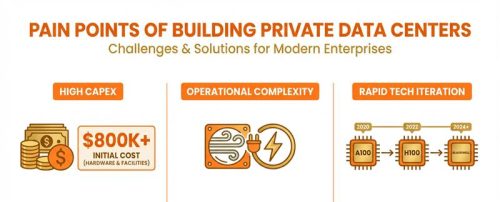
- High upfront capital expenditure (CAPEX): According to Lenovo analysis, the total cost of ownership (TCO) of an enterprise-grade server equipped with eight NVIDIA H100 GPUs is close to USD 800,000. Deploying a multi-node GPU cluster capable of supporting large-model training can easily push total costs beyond USD 1 million. [1]
- Operational complexity: High-performance GPUs introduce challenges related to heat dissipation, power supply, and network latency. These require specialized data center infrastructure, including power redundancy, advanced cooling solutions, and high-bandwidth backbone networks. [4]
- Rapid technology iteration: AI GPU generations evolve quickly. NVIDIA, for example, has moved from A100 and H100 to Blackwell B200 and GB200 within just a few years, often delivering multiple-fold performance improvements. Purchased equipment may become obsolete before it is fully depreciated. [2]
As a result, the cloud compute power rental model has emerged. It enables enterprises to access state-of-the-art computing resources on demand, converting large one-time capital expenditures (CAPEX) into flexible operating expenses (OPEX). This allows organizations to remain agile and focus their efforts on core business innovation. [1]
Advantages and Business Value of AI Compute Power Leasing
Choosing AI compute power leasing is not only about cost savings. It is also a strategic decision to improve operational efficiency. Below are the key advantages this model offers.
1. Flexibility and Elastic Scalability
AI projects typically follow clear phases. During the model training stage, demand for compute power reaches its peak. During inference or application deployment, demand is often more stable. [5]
With compute power leasing, enterprises can adjust the number of GPUs flexibly according to project progress. For example, hundreds of GPUs can be rented for several weeks during large language model (LLM) training. Once training is completed, resources can be released immediately, avoiding idle capacity and unnecessary waste. [3]
2. Immediate Access to the Latest Hardware Technologies
Hardware vendors continuously release more powerful computing chips. For enterprises that build and operate their own data centers, it is difficult to keep pace with these rapid hardware upgrades. Professional cloud compute power providers typically deploy the latest hardware as soon as it becomes available. This allows tenants to avoid concerns about hardware depreciation and consistently access highly efficient computing capabilities. For example, users can move quickly from A100 to H100 GPU clusters and upgrade directly within their rental plans to the latest platforms. [3]
3. Greater Focus on Core Business Innovation
Maintaining a high performance computing (HPC) environment requires dedicated IT teams to manage power supply, cooling systems, network architecture, and hardware failures. By adopting compute power leasing services, enterprises can offload these complex infrastructure operations to service providers. This allows internal data scientists and engineers to focus on algorithm optimization and model development, helping shorten time to market. [4]
Which Industries Require AI Compute Power Leasing Services?
AI compute power leasing has become a critical tool for accelerating digital transformation and overcoming hardware cost barriers across industries. It is particularly valuable in sectors with extremely high demands for large-scale data processing and real-time computing. Leasing enables fast deployment and flexible scalability to achieve strategic objectives.:
- Healthcare and Biotech: Tasks such as molecular modeling for drug discovery, protein folding simulations, and genome sequencing require very high GPU memory bandwidth. By renting cloud GPU resources, research teams can significantly shorten drug screening cycles and support high-precision medical image analysis, improving diagnostic accuracy.
- Financial Services: Financial institutions process massive datasets for risk assessment, fraud detection, and complex algorithmic trading. Compute power leasing allows enterprises to flexibly scale GPU clusters during periods of market volatility or surging computational demand, releasing resources once tasks are completed, and optimizing operational costs.
- Generative AI and SaaS Developers: Many startups and technical teams are developing proprietary large language models (LLMs) or image generation tools, which require extremely high compute power during the training phase. With high-end GPUs such as the H100 in short supply and expensive to procure, leasing allows developers to bypass long hardware delivery cycles and start projects immediately, focusing on algorithm optimization and innovation.
- Autonomous Driving and Manufacturing: Autonomous driving relies on deep learning to analyze vast amounts of sensor data to optimize vehicle decision-making. Compute power leasing provides manufacturers with the high-performance environment needed to process massive amounts of road test data while avoiding the high capital costs of building and maintaining large AI-focused data centers.
- Retail and E-commerce: Retailers use generative AI and machine learning for precise consumer behavior prediction, sentiment analysis, and highly personalized recommendation systems. Cloud compute leasing enables businesses to adjust computational resources flexibly according to traffic fluctuations during peak shopping periods, such as Singles’ Day or Black Friday, ensuring stable user experiences under high concurrency.
Types of Compute Power Leasing
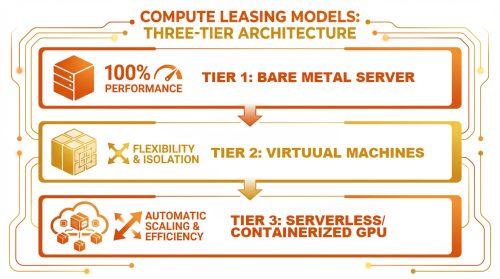
When selecting an AI compute power leasing service, enterprises should choose a model based on the scale of model training and the level of hardware control required. The main leasing models currently available in the market can be classified into three categories:
1. Bare Metal Server
Bare metal server leasing provides enterprises with direct access to physical servers. Its main feature is the complete removal of the virtualization layer, allowing GPUs to deliver 100% of their native compute performance. [3]
Because the entire server is dedicated to a single tenant, this leasing model eliminates resource contention issues, ensuring performance remains stable regardless of other users’ workloads. It is ideal for enterprise projects that require maximum compute stability, large-scale parallel training (such as full-parameter LLM training), and strict data privacy requirements. [9]
2. Virtual Machines
Virtualization technology partitions physical hardware resources, enabling enterprises to rent a specific number of GPU cores and memory more flexibly. [3] Virtual machines offer high scalability, fast startup times, and flexible deployment. They are particularly suitable for AI model inference, small to medium model fine-tuning, or early proof-of-concept projects, providing on-demand compute power at a lower barrier to entry. [8]
3. Serverless and Containerized GPU
This is a highly abstracted, on-demand model where developers simply deploy AI code or preconfigured AI environments (for example, using Docker) to the platform. The system automatically allocates and reclaims compute resources based on workload. [3]
The main advantage of this model is that there is no need to manage underlying infrastructure, and billing is based entirely on actual compute usage. It is highly cost-effective and convenient for non-continuous batch processing, temporary model testing, or lightweight AI application development. [8][9]
Factors to Consider When Choosing Cloud Compute Leasing Services
With many providers on the market—from large public clouds to vertical-focused GPU cloud services—enterprises need to evaluate cloud compute leasing solutions based on more than price. Key technical specifications and service commitments include:
1. Hardware Specifications and Cluster Performance
Not all GPUs are suitable for AI training. Enterprises should verify whether the GPU models provided by the vendor meet model requirements, such as memory size and FP16/FP32 compute capabilities. More importantly, cluster performance must be considered. [5] Training large AI models often requires multi-GPU and multi-node parallelism, making interconnect bandwidth between GPUs, such as NVLink or InfiniBand, critical. Low-latency, high-bandwidth network architectures ensure efficient collaboration between multiple GPUs and prevent communication bottlenecks from slowing training.
2. Data Center Infrastructure Standards
AI computing generates significant heat and demands high power density. Traditional data centers may not handle the cooling needs of high-density GPU servers. When evaluating compute leasing partners, enterprises should check whether their data centers are “AI ready.” This includes high-power-density rack design, stable and redundant power systems, advanced cooling technologies such as liquid cooling to support high-power GPUs, and compliance with Tier 3 or higher reliability standards. These measures ensure training processes are not interrupted by power outages or overheating. [6]
Further reading: What is an AI-Ready Data Center?
3. Data Security and Privacy Compliance
For industries such as finance, healthcare, or government, data privacy is a top priority. When using cloud compute leasing, enterprises must clarify the data storage location (data residency) and the encryption methods applied during data transfer. Companies should prioritize providers with multiple security certifications, such as ISO 27001, and those compliant with local regulations. Some may even consider leasing solutions based on private or hybrid cloud architectures to ensure the security of critical data assets. [7]
4. Pricing Models and Cost-Effectiveness
Different compute leasing models correspond to different cost structures. Enterprises should choose the most suitable combination based on project requirements, such as urgency and budget, rather than simply pursuing the lowest price. Common models include: [8]
| Model | Characteristics | Suitable Scenarios |
|---|---|---|
| On-Demand | Can be started and stopped at any time, but unit cost is relatively high | Proof of concept tests, short-term trials, or projects with fluctuating demand |
| Reserved | Long-term commitment with significant price discounts | Projects requiring advance reservation of resources or long-running AI model training |
| Spot / Idle Resources | Temporarily unused compute resources offered at the lowest cost; may be reclaimed by the system when demand rises | Non-critical tasks with high fault tolerance, where interruptions do not affect the final outcome, such as data cleaning or non-core model fine-tuning |
Delivering a High-Performance Computing Experience for the AI Era
In the AI era, compute power equals productivity. For most enterprises, building a large-scale compute infrastructure in-house is neither cost-effective nor practical. By leveraging professional compute leasing services, organizations can access top-tier computing resources more quickly and at lower cost, allowing them to focus on algorithm innovation and business applications. [9]
OneAsia is dedicated to providing enterprises with world-class digital infrastructure. Our AI-ready data centers feature high-density power supply and advanced liquid-cooling technology, ensuring the stable operation of high-end GPU clusters. We help you meet demanding AI compute leasing requirements with ease. Whether you need flexible cloud resources or managed AI servers, OneAsia delivers secure, reliable, and high-performance solutions tailored to your needs.
References:
[1]LenovoPress – On-Premise vs Cloud: Generative AI Total Cost of Ownership
[2]eWEEK – NVIDIA Blackwell AI Chip Sold Out Due to Skyrocketing Demand
[3]Cyfuture – Understanding GPU as a Service (GPUaaS) in 2025
[4]Cudo Compute – Building AI infrastructure in-house vs using external experts
[5]MobiDev – GPU for Machine Learning & AI in 2025: On-Premises vs Cloud
[6]Fiegenbaum – AI’s Growing Energy Demand: Challenges & Sustainable Data Centers
[7]NCS Singapore – Green Cloud Computing and its role in sustainable AI
[8]NetworkWorld – Cloud-based GPU savings are real – for the nimble
[9]AceCloud – Real World Business Benefits Of Cloud GPU