
What Are AI Data Center Requirements? A GPU, Power and Cooling Guide
Blog / What Are AI Data Center Requirements? A GPU, Power and Cooling Guide
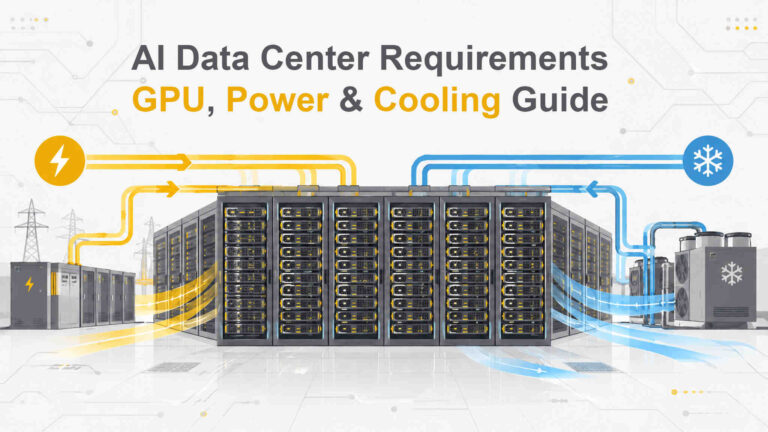
The rapid expansion of Generative AI and Large Language Models (LLMs) is pushing enterprise IT infrastructure beyond standard operational limits. Traditional data centers engineered for web hosting and cloud workloads cannot support the computational demands of modern machine learning.
Understanding today’s critical AI data center requirements is no longer just an IT consideration; it is a vital strategy for organizations aiming to stay competitive. From high-density processing power to unprecedented utility loads, accommodating artificial intelligence requires a total transformation of core facility design. In this comprehensive guide, we unpack the essential GPU requirements for AI data centers, analyze the heavy demands driving power requirements for AI data centers, and explore the cooling solutions needed to meet evolving cooling requirements in AI data centers.
The Evolution of Data Centers for Artificial Intelligence
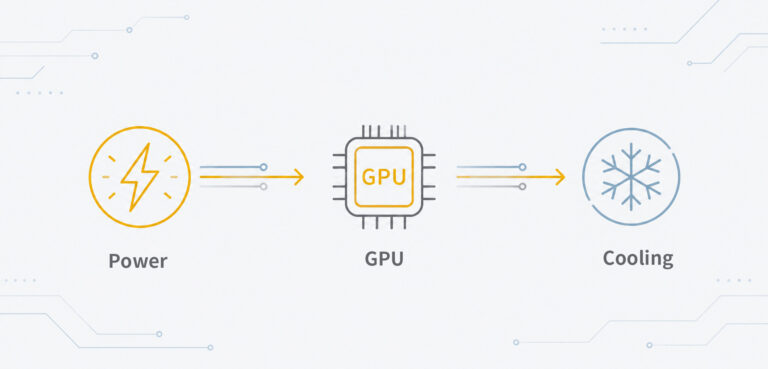
Legacy facilities handle predictable workloads with average rack power densities of 5 kW to 10 kW. In contrast, training and inference clusters demand parallel processing power that pushes density from 30 kW to over 100 kW per cabinet.
AI training relies on processing large datasets through neural networks with billions of parameters. This shift requires an architecture where compute, power distribution, thermal systems, and network fabrics operate together without performance bottlenecks.
Essential AI Data Center GPU Requirements and Hardware Architecture
Transitioning to high-performance computing requires a fundamental rethink of underlying infrastructure. Data centers must transition from standard general computers to hosting dense, interconnected hardware engines.
High-Density GPU Clusters and Compute Nodes
Satisfying modern AI data center GPU requirements involves more than installing high-performance accelerators. It demands dense server configurations engineered for continuous matrix math operations under maximum load.
Low-Latency Fabric and High-Bandwidth Networking
Accelerated clusters must communicate continuously during distributed training. Facilities rely on ultra-low-latency interconnects, such as InfiniBand and RoCE (RDMA over Converged Ethernet), delivering speeds between 400 Gbps and 800 Gbps per node to eliminate transfer bottlenecks.
Storage Throughput for Massive AI Datasets
Data-intensive processing requires high-speed input/output pipelines. AI-ready storage architectures use All-Flash NVMe fabrics capable of high throughput and parallel operations to prevent hardware starvation.
Mastering AI Data Center Power Requirements and Energy Efficiency
Meeting AI data center power requirements involves physical and electrical planning to keep high-performance processors running without disruption.
Unprecedented Kilowatt and Megawatt Density Demands
While standard enterprise racks draw under 10 kW, high-density AI cabinets regularly consume 40 kW to 120+ kW. Scaling these GPU-heavy clusters rapidly pushes total facility capacity into multi-megawatt ranges.
Redundancy, Power Distribution, and Battery Backup (UPS)
Uptime is critical. A power disruption during a multi-week training run results in lost computation and corrupted checkpoints. AI facilities require robust N+1 or 2N UPS configurations, heavy-duty power distribution units (PDUs), and stable backup architectures.
Sustainable Energy Strategy and PUE Optimization
Higher power consumption requires a focus on operational efficiency. Modern facilities improve Power Usage Effectiveness (PUE) through renewable energy integration, dynamic load balancing, and targeted power management to control operational costs and environmental impact.
Advanced AI Data Center Cooling Requirements and Thermal Management
Virtually all electrical energy consumed by modern accelerators converts directly into heat. As a result, meeting modern cooling requirements for AI data centers is a major operational focus for facility operators.
The Limits of Traditional Air Cooling
Standard Computer Room Air Conditioners (CRAC) are inefficient when rack densities exceed 30 kW. Air cooling alone cannot dissipate heat quickly enough from densely packed processor dies.
Liquid Cooling Innovations: Direct-to-Chip and Immersion Cooling
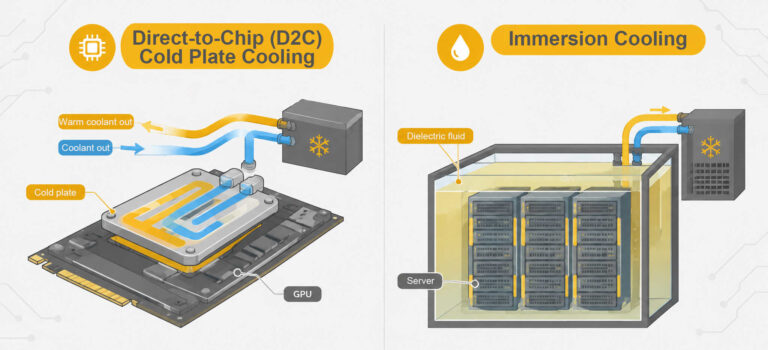
To manage extreme heat loads, AI data centers are transitioning to liquid cooling solutions, which are up to 3,000 times more effective at heat transfer than air:
- Direct-to-Chip (D2C) Cold Plate Cooling: Circulates coolant through cold plates mounted directly on GPUs and CPUs, removing heat at the source.
- Immersion Cooling: Submerges server components entirely in non-conductive dielectric fluid for maximum thermal dissipation across the entire hardware footprint.
Hybrid Thermal Strategies and Heat Reuse
Many hybrid facilities combine liquid cooling loops for high-density AI clusters with rear-door heat exchangers (RDHx) or air cooling for traditional management nodes, optimising overall facility efficiency and exploring waste-heat recovery options.Standard Computer Room Air Conditioners (CRAC) are inefficient when rack densities exceed 30 kW. Air cooling alone cannot dissipate heat quickly enough from densely packed processor dies.
Network Interconnection, Spatial, and Structural Planning
Facilities must support physical structural weight and enable rapid external network data movement alongside core power and cooling systems.
Carrier-Neutral Interconnection and Ecosystem Access
Deployment efficiency relies on fast access to cloud providers, carrier networks, and edge nodes. Data centers require carrier-neutral interconnect networks for efficient data ingestion and model distribution.
Spatial Footprint and Structural Load Capacity
Dense server racks and liquid cooling systems increase physical weight. Facilities designed for high-performance computing need reinforced flooring to handle structural load capacities, along with space for liquid piping manifolds and heavy busway runs.
How to Choose an AI-Ready Data Center Provider?
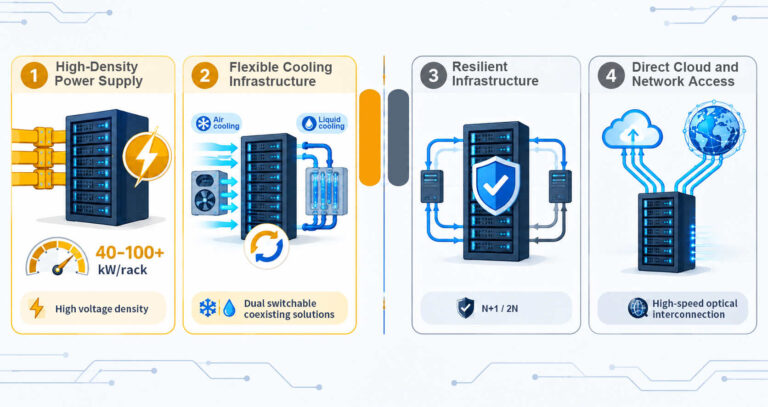
Building internal high-density facilities requires significant capital expenditure and lengthy deployment timelines. Partnering with a specialized colocation provider allows enterprises to deploy quickly while managing operational risks.
Key evaluation criteria for a facility partner include:
- High-Density Power Supply: Scalable infrastructure capable of supporting 40 kW–100+ kW per rack.
- Flexible Cooling Infrastructure: Hybrid options supporting both high-efficiency air and advanced liquid cooling deployments.
- Resilient Infrastructure: Proven N+1 or 2N redundancy with optimized low PUE metrics.
- Direct Cloud and Network Access: High-throughput, low-latency connectivity options to global ecosystems.
Future-Proof Your Infrastructure with OneAsia’s AI-Ready Solutions
Addressing complex data center requirements for AI requires purpose-built operational architecture. Balancing high-density compute, utility demands, and advanced thermal management requires dedicated expertise and facilities built for heavy workloads.
Partnering with an experienced colocation provider allows your organization to scale computing capacity, manage complex power and cooling requirements for AI data centers, and run hardware configurations at peak efficiency.
OneAsia Network Limited provides scalable and sustainable data center solutions engineered for demanding machine learning workloads. Whether deploying model training clusters or scaling low-latency inference, our facilities deliver the reliability and density your business requires. Contact us to discover how our custom high-density solutions can accelerate your AI deployment.
Frequently Asked Questions
1. What is needed to run an AI data center?
High-density GPU compute nodes, high-capacity power infrastructure, advanced liquid cooling, and ultra-low-latency networking. Facilities must support power loads exceeding 40 kW to 120+ kW per rack while utilizing direct-to-chip or immersion cooling to handle extreme thermal densities that traditional air cooling cannot manage.
2. How much electricity do AI data centers consume?
Roughly 4 to 10 times more electricity per rack than traditional enterprise data centers. Individual high-density AI racks draw between 40 kW and 120+ kW, pushing full-scale AI training facilities to require tens to hundreds of megawatts of continuous grid capacity.
3. How much water do AI data centers use for cooling?
Up to several million gallons of water daily when relying on traditional evaporative cooling systems. To minimize water consumption and environmental impact, modern facilities are rapidly transitioning to closed-loop liquid cooling technologies and immersion systems that continuously recirculate coolants with near-zero fluid loss.
References
- Cisco Blogs – Future-Proof Your Data Center for AI: A Checklist for Designing and Building AI Data Centers
- IEA – International Energy Agency – Energy demand from AI
- Uptime Intelligence – Uptime Institute Global Data Center Survey 2025
- ASHRAE – Equipment Thermal Guidelines for Data Processing Environments