
Cloud Computing vs. Edge Computing: A Complete Comparison Guide for the AI Era
Blog / Cloud Computing vs. Edge Computing: A Complete Comparison Guide for the AI Era
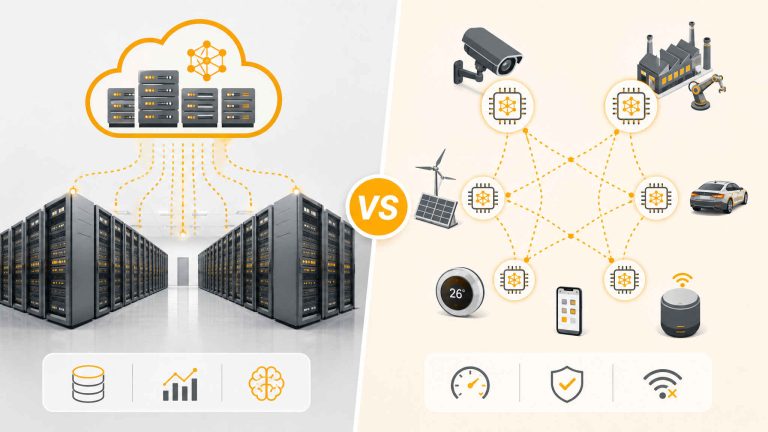
In today’s rapidly evolving AI landscape, data processing speed and efficiency have become critical competitive advantages for businesses. When deploying AI applications, organizations often face a key decision: should they rely on the massive computational power of cloud AI for deep analysis, or leverage edge AI for real-time responsiveness? In reality, the choice is not necessarily one or the other. The optimal approach is often determined by business requirements and workload distribution. This guide compares edge computing and cloud computing, helping you understand their respective use cases and how they can be combined to build a more flexible and efficient AI-driven architecture.
What Are Cloud AI and Edge AI?
While both approaches enhance AI processing capabilities, they differ significantly in terms of computing resource allocation and data transmission paths. Below is an overview of how cloud AI and edge AI operate and where they are commonly applied.
Cloud AI (Cloud Computing)
Cloud computing involves transmitting large volumes of data to remote data centers for processing. These facilities provide virtually unlimited storage capacity and powerful GPU resources, delivering services such as data storage, processing, and AI model training over the internet.
Within a cloud AI architecture, organizations can:
- Store vast amounts of data for large-scale aggregation and analysis
- Scale computing resources rapidly to support AI model training
- Utilize cloud-native technologies such as containers and microservices to improve flexibility and portability
Cloud AI is particularly well suited for applications that do not require immediate responses but demand extensive computational resources and centralized management, such as:
- AI model training
- Business intelligence and analytics
- Large-scale database services
However, transmitting significant amounts of data to the cloud may increase bandwidth and storage costs, while network instability can potentially affect performance and response times.
Edge AI (Edge Computing)
Edge computing processes data closer to where it is generated. AI algorithms are executed directly on endpoint devices such as industrial sensors, smart cameras, or in-vehicle computers. Since data does not need to travel to a centralized data center for immediate processing, decisions can be made in real time—for example, detecting anomalies or triggering alerts.
Common edge AI applications include:
- Industrial sensor systems in manufacturing facilities
- Intelligent transportation infrastructure
- Smart cameras and endpoint devices in retail stores and shopping malls
The key advantage of edge AI is its ability to significantly reduce latency. Instead of transmitting all raw data to the cloud, only summarized results or selected datasets need to be sent back when necessary. This approach helps reduce bandwidth consumption and cloud storage costs while enabling reliable operation even in environments with unstable network connectivity.
Edge Computing vs Cloud Computing: A Comparison Across Five Key Areas
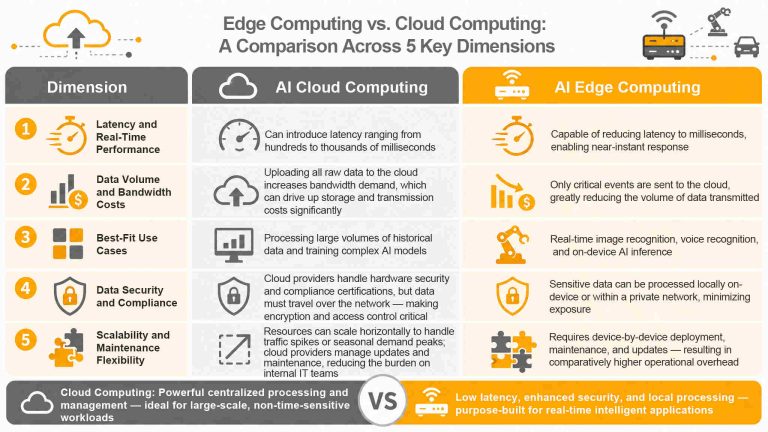
| Aspect | AI Cloud Computing | AI Edge Computing |
|---|---|---|
| Latency & Real-Time Performance | May experience delays ranging from hundreds to thousands of milliseconds | Can reduce latency to milliseconds or near real-time |
| Data Volume & Bandwidth Costs | Uploading all raw data to the cloud increases bandwidth demand and may drive up cloud storage and network costs | Only critical events are uploaded to the cloud, reducing data transmission volume |
| Suitable Applications | Processing large volumes of historical data and training complex AI models | Real-time image recognition, speech recognition, and AI inference |
| Data Security & Compliance | Cloud providers are responsible for hardware security and compliance certifications, but data must be transmitted over networks, requiring encryption and access controls | Sensitive data can be processed within local networks or devices |
| Scalability & Maintenance Flexibility | Resources can be scaled horizontally to support traffic spikes and seasonal demand; updates and maintenance are handled by cloud providers, reducing the burden on local IT teams | Devices must be deployed, maintained, and updated individually, resulting in higher maintenance costs |
How Cloud Computing and Edge Computing Complement Each Other
Modern AI applications no longer rely exclusively on either cloud computing or edge computing. Instead, organizations increasingly adopt a hybrid approach that allows both architectures to work together and perform different roles.
In general, cloud computing is responsible for centralized data analysis and AI model training. For example, it can aggregate data collected from factories and use it to train more accurate predictive models. Edge computing, on the other hand, focuses on real-time processing and on-site decision-making, such as monitoring equipment anomalies through factory sensors.
Edge Computing for Real-Time Processing and On-Site Decision-Making
Edge computing is ideal for latency-sensitive scenarios that require reliable local operations or where data transmission costs are high. Common applications include:
- Factory Sensors: Continuously monitor equipment temperature, vibration, and noise levels. When abnormalities are detected, alerts can be triggered immediately or machinery can be automatically shut down without waiting for cloud responses.
- Retail Stores and Public Spaces: AI-enabled cameras analyze customer traffic, movement patterns, and hotspot areas, while only transmitting summarized insights or event data to the cloud.
- Connected Vehicles and Intelligent Transportation: Vehicles and roadside systems can instantly assess vehicle distance, speed, and lane positioning, issuing warnings or applying brakes within milliseconds when necessary.
Cloud Computing for Centralized Analytics and Model Training
Organizations can leverage cloud computing to aggregate and analyze data collected from multiple edge devices, identify long-term trends, and train AI models. Examples include:
- Retail and Store Operations: Consolidating sales and customer traffic data from multiple locations to analyze annual trends, seasonal patterns, and consumer preferences, helping optimize marketing strategies and inventory planning.
- Connected Vehicles and Smart Transportation: Aggregating data from vehicles and traffic intersections to improve traffic signal management and support smarter urban transportation planning.
By combining cloud and edge computing, enterprises can benefit from the cloud’s scalability and large-scale computing power while leveraging edge computing to improve responsiveness and control costs.
How Should Enterprises Choose the Right Architecture?
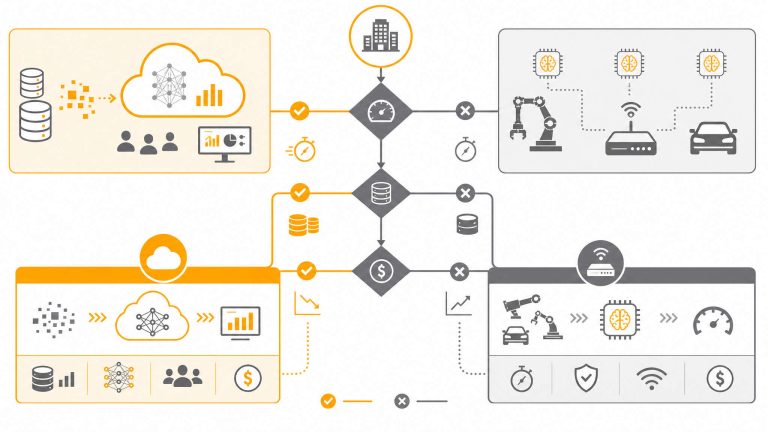
After understanding the differences between cloud computing and edge computing, organizations should not treat them as mutually exclusive options. Instead, they should determine which architecture should play the primary role and which should serve as a supporting component based on business requirements.
For example:
- If the goal is real-time control and ultra-low latency, edge computing should take the lead. Critical decisions are made locally, while the cloud handles analytics and model optimization. Typical use cases include autonomous vehicles, predictive maintenance for industrial equipment, and smart transportation systems.
- If the goal is aggregating large datasets, analyzing long-term trends, and integrating information across multiple domains, cloud computing should be the primary platform, with edge devices performing only basic real-time processing and data filtering.
When planning an architecture, organizations should first evaluate latency requirements, data volumes, and compliance obligations before deciding whether cloud or edge computing should be prioritized.
Scenarios Best Suited for Cloud Computing
Cloud computing is generally the preferred choice when:
- Multiple AI models need to be trained for applications such as speech recognition, image classification, and natural language processing (NLP).
- Large-scale data analytics, backup, and disaster recovery are required.
- Applications such as annual sales analysis and customer behavior analysis can tolerate several seconds of latency but require substantial computing resources.
- The organization already has stable internet connectivity and prefers a service-based model to reduce upfront infrastructure investment.
In these scenarios, cloud computing typically serves as the primary computing platform, while edge devices collect or filter data locally before uploading streamlined datasets to the cloud.
Scenarios Best Suited for Edge Computing
Edge computing is particularly suitable for:
- Autonomous driving and industrial equipment control that require immediate decision-making and response.
- High-frequency sensor data where uploading all information to the cloud is impractical or costly.
- Applications involving medical imaging, critical manufacturing parameters, or personal data that require stringent privacy protection and regulatory compliance.
In these situations, edge computing handles real-time processing and local decision-making, while the cloud serves as a platform for advanced analytics and continuous AI model improvement.
OneAsia Builds High-Performance AI Infrastructure for Your Business
Both edge computing and cloud computing offer unique and irreplaceable advantages. Edge AI addresses challenges related to latency and local data privacy, while cloud AI provides virtually unlimited computing power for AI model training and large-scale data processing.
A comprehensive comparison of edge computing and cloud computing demonstrates that integrating both technologies enables enterprises to accelerate digital transformation and remain competitive in a rapidly changing market.
OneAsia’s cloud computing services provide a secure and easy-to-manage platform for computing and storage. Organizations can confidently centralize non-real-time, high-complexity workloads and data analytics in the cloud while assigning latency-sensitive applications to edge computing nodes, ensuring each technology performs the tasks it is best suited for and maximizing overall operational efficiency.