
What Is AI in Education? Understanding the Impact and Application Trends of AI in Education and How It Is Transforming the Future of Primary & Secondary Schools and Higher Education
Blog / What Is AI in Education? Understanding the Impact and Application Trends of AI in Education and How It Is Transforming the Future of Primary & Secondary Schools and Higher Education
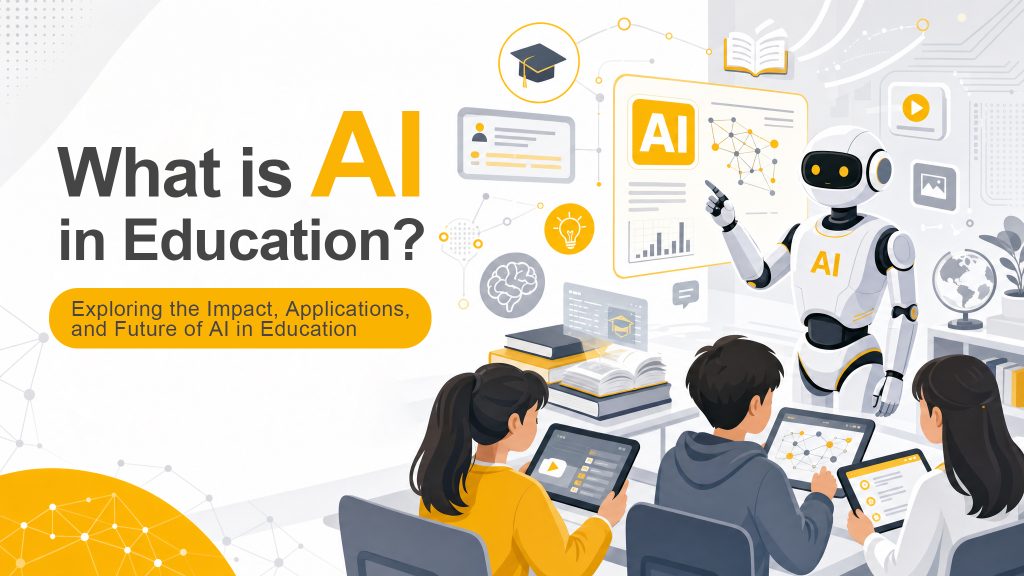
AI in education is reshaping the educational ecosystem through the integration of adaptive learning platforms and generative AI, helping address challenges such as unequal resource distribution and administrative burdens. AI-powered educational applications enable students to access intelligent tutoring assistance anytime, while teachers evolve into facilitators and guides for AI tools. In this article, OneAsia explores the impact of AI on education, explains the concept and core value of AI in education, examines future trends and current challenges, and highlights how blended learning models are revolutionizing primary, secondary schools and higher education.
What Is AI in Education? Definition and Core Value
AI in Education (AIEd) does not simply refer to teaching students about artificial intelligence. Its core concept lies in applying AI technologies to teaching, learning, and educational administration. AI in education aims to use data-driven insights to address issues such as uneven allocation of teaching resources and excessive administrative workloads for educators, while creating more personalized learning experiences for students.
AI can serve as an “intelligent teaching assistant” for educators and a “personalized tutor” for students, rather than replacing teachers altogether.
Why Adopt AI?
AI helps overcome the limitations of traditional large-scale classroom teaching. In conventional classroom settings, teachers often struggle to accommodate each student’s learning pace individually, whereas AI can act as an assistant that supports personalized learning.
Through automation, teachers can focus more on student engagement and meaningful interactions while reducing time spent on repetitive administrative work. At the same time, AI helps students develop self-directed learning pathways and improves the utilization efficiency of educational resources.
Applications of AI in Education
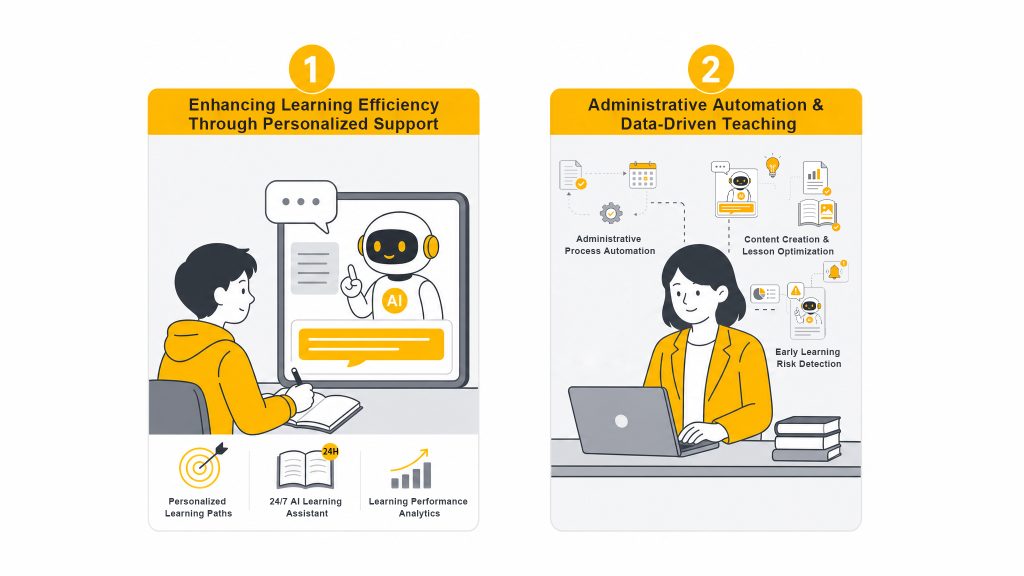
The breadth and depth of AI applications in education continue to expand, with significant impacts on both student learning and teaching practices.
Enhancing Student Learning Efficiency and Personalized SupportEnhancing Student Learning Efficiency and Personalized Support
AI can provide instant feedback based on each student’s learning pace and facilitate personalized education:
- Adaptive Learning Paths: By analyzing mistakes made in quizzes and exercises, AI systems can automatically recommend suitable learning materials that match the student’s current ability level.
- 24/7 Intelligent Tutoring Assistance: Students can consult AI tools regarding coursework and conceptual questions, significantly reducing the waiting time for obtaining knowledge and support.
- Learning Performance Analysis: Research indicates that students who appropriately utilize AI-assisted learning receive better feedback when tackling complex problems, helping them better understand core course concepts.[1]
Administrative Automation and Precision Teaching for Educators
AI helps educators streamline administrative processes and improve teaching effectiveness:
- Administrative Process Automation: AI can assist with grading assignments, compiling scores, and scheduling classes, reducing the time teachers spend on repetitive administrative tasks.
- Teaching Material Design and Optimization: Teachers can use AI to generate lesson plans, practice question banks, and analytical reports, significantly reducing preparation time.
- Learning Risk Alerts: By analyzing classroom learning data, AI can help teachers identify students who may be falling behind or losing motivation and provide timely intervention and support.
The Impact of AI on Education: Reshaping Teaching Paradigms
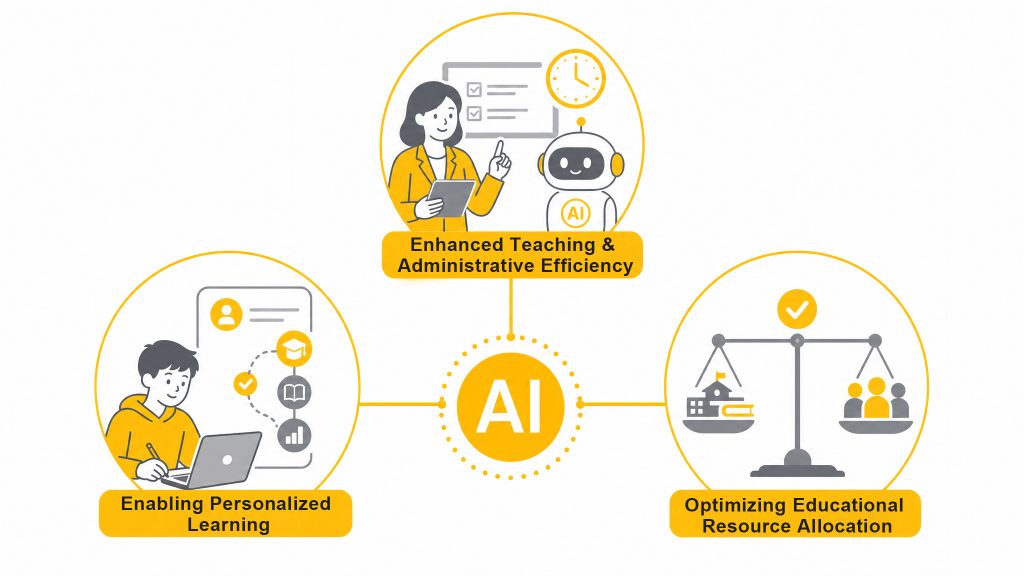
The use of AI in education has become an established trend, with impacts that can be examined from both opportunities for educational enhancement and practical challenges.
Improving Precision Teaching and Administrative Efficiency
The impact of AI on education includes the following three major benefits:
- Enhanced Teaching and Administrative Efficiency: AI technologies can automate repetitive tasks such as grading, score compilation, and class scheduling, allowing educators to devote more attention to lesson design and student interaction, ultimately improving teaching quality.
- Promotion of Personalized Learning (Adaptive Learning): AI systems can instantly analyze student assignments, learning progress, and error patterns to create customized learning paths for individual students.
- Optimization of Educational Resource Allocation: Through AI-driven digital learning platforms, high-quality educational resources can overcome geographical limitations and help reduce educational disparities between different regions.
Educational Challenges Facing AI
Despite its benefits, AI adoption in education requires careful consideration of potential risks:
- Reduced Independent Thinking Ability: Overreliance on AI-generated answers may weaken students’ understanding of complex concepts and their independent thinking skills. Educators must balance the use of AI tools with the continued development of critical thinking abilities.
- Academic Integrity and Ethical Concerns: AI-assisted tools may increase the risk of plagiarism and academic misconduct, making it necessary for educational institutions to establish clear guidelines and review mechanisms.
- Data Privacy and Security Requirements: Educational applications involve large volumes of student and faculty data. Institutions must ensure data security during processing and comply with cybersecurity regulations.
What Are the Future Trends of AI in Education?
Looking ahead, future AI education trends will emphasize deeper integration, secure implementation, and ethical considerations. Teachers will gradually transition from knowledge transmitters to learning facilitators and AI mentors.
Blended education models will not only focus on the use of AI tools but also incorporate AI ethics, algorithmic bias awareness, and critical thinking development into curricula. Meanwhile, educational institutions will need to upgrade high-performance computing infrastructure to support increasingly complex AI models.
Future Educational Demand for AI Technologies
For AI education applications to continue advancing, the key challenge lies in whether technology can support increasingly sophisticated educational scenarios.
Future educational technologies must move beyond basic content generation capabilities and develop contextual awareness and deep diagnostic capabilities to analyze students’ thinking processes and learning patterns. At the same time, educational institutions must overcome the challenge of securely handling highly sensitive personal data in large-scale computational environments.
Building an Efficient Learning Environment for the Future: OneAsia’s Professional Solutions
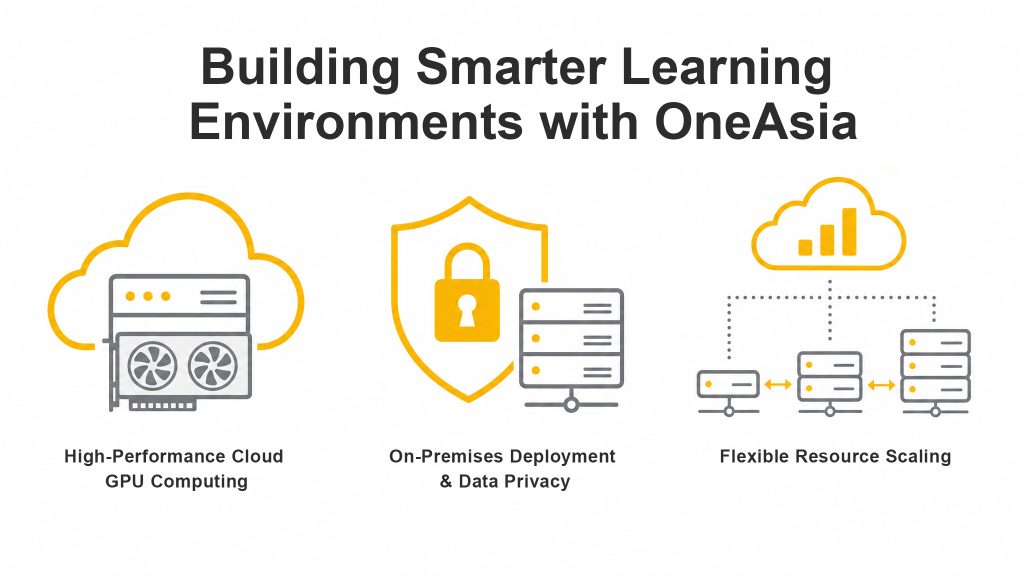
Successful implementation of AI education requires reliable computing resources. OneAsia is committed to providing educational institutions with secure and high-performance automated learning environments:
- High-Performance Cloud GPU Computing Power: Providing GPU resources to support machine learning and data analytics workloads. Schools can run AI models and educational software directly in the cloud without investing in and maintaining server hardware.
- Localized Deployment and Data Privacy Protection: Offering on-premises deployment solutions that comply with cybersecurity regulations, ensuring that data storage and computation remain local and reducing privacy risks associated with public cloud environments.
- Flexible Resource Scaling: GPU resources can be increased or decreased instantly according to educational project requirements or course demands. This pay-as-you-use model helps institutions control hardware procurement and maintenance costs within budget.
Accelerate AI Education Deployment with OneAsia Cloud
From AI applications in classrooms to campus-wide infrastructure upgrades, these technologies can improve administrative efficiency while deepening personalized learning experiences.
As the impact of AI on education continues to grow, understanding future AI education trends and establishing robust data processing environments will become essential for enhancing educational competitiveness. OneAsia’s Cloud Services help institutions build secure and efficient learning environments while empowering students with the digital skills needed for the future.
References: