
What Is an IDC Data Center? Selection Criteria and Core Services Explained
Blog / What Is an IDC Data Center? Selection Criteria and Core Services Explained
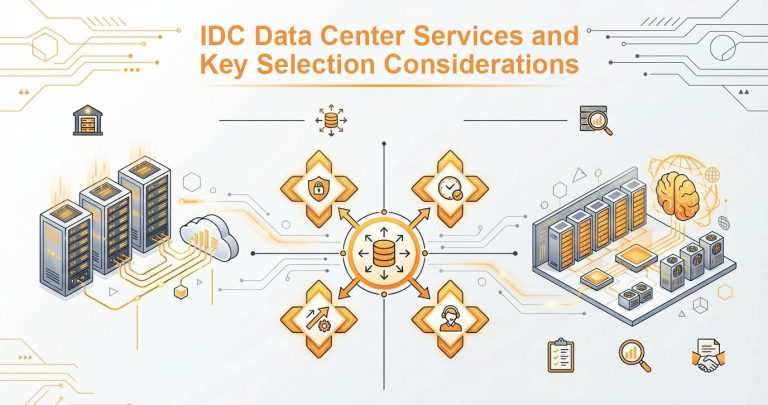
In today’s digital-first business environment, stable IT infrastructure is essential. Whether it’s a corporate website, e-commerce platform, or internal management system, all rely on reliable backend support. A data center is no longer just a place to store equipment—it plays a critical role in ensuring uninterrupted operations. Many business leaders ask: What is an IDC? What do different data center tiers mean? This article will clearly explain the concept of IDC data centers and how to choose the right service for your business.
What Is an IDC? Definition of a Data Center
IDC (Internet Data Center) refers to a facility specifically designed to house servers, network equipment, and other IT hardware. It serves as the central hub for system operations and data processing.
Put simply, an IDC is the backbone of a company’s IT systems. It hosts the infrastructure that supports websites, e-commerce platforms, membership systems, and internal applications—within a highly stable environment featuring strict temperature control and uninterrupted power supply. If the data center environment is unstable, it can lead to service outages, negatively impacting user experience, brand reputation, and even causing financial loss.
Types of IDC Data Centers
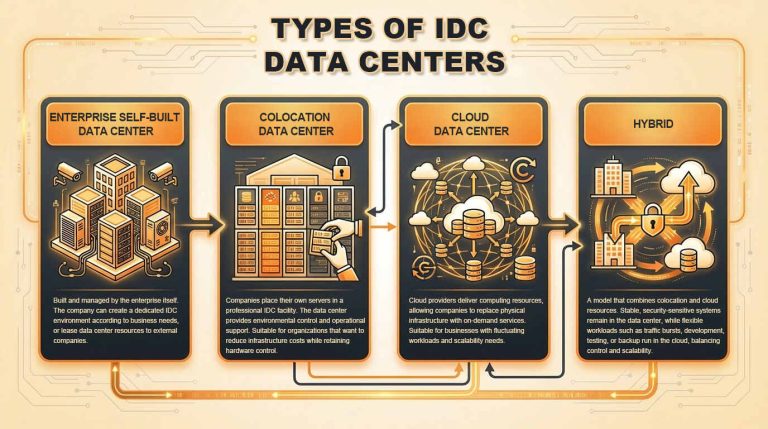
IDC data centers can be categorized based on their usage and service models:
- Enterprise Data Center: Built and managed by the enterprise itself. Suitable for organizations requiring full control and customization, and sometimes used to lease resources to others.
- Colocation Data Center: Businesses place their own servers in a third-party IDC facility, which provides infrastructure support such as power, cooling, and security. Ideal for companies that want hardware control without building their own data center.
- Cloud Data Center: Operated by cloud service providers. Businesses rent computing resources instead of owning physical infrastructure, making it suitable for dynamic workloads and scalable operations.
- Hybrid Data Center: Combines colocation and cloud solutions. Critical systems are hosted in physical data centers, while flexible workloads (e.g., testing, backups, or traffic spikes) are handled in the cloud—balancing control and scalability.
Why Are IDC Data Centers Important for Businesses?
IDC data centers provide a stable operating environment, allowing businesses to focus on development and growth instead of infrastructure uncertainties.
Key benefits include:
- Reduced downtime risk: Minimizes service interruptions and operational disruptions.
- Improved operational control: Standardized management reduces human error and enhances system reliability.
- Scalability support: Enables structured expansion of IT resources as business demands grow, avoiding sudden infrastructure bottlenecks.
Can Businesses Build Their Own IDC?
From a technical perspective, building a private IDC is possible. However, it is typically suitable only for large enterprises with extensive infrastructure needs and highly customized requirements—such as those in finance, telecommunications, or large-scale digital platforms.
Self-built data centers involve high upfront investment, along with ongoing costs for maintenance, operations, and incident management. For companies with limited IT resources or rapidly changing business needs, this approach may reduce flexibility. In many cases, renting IDC services is more cost-effective and scalable.
What Services Do IDC Data Centers Provide?
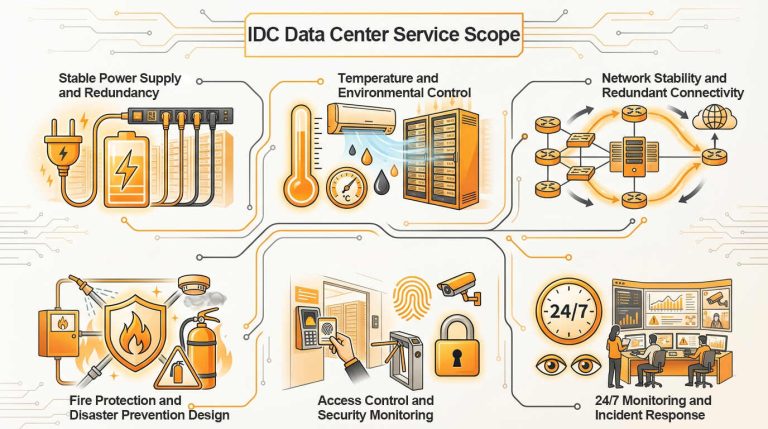
When choosing an IDC provider, businesses should evaluate whether the offered services can ensure stable system operations. Common service offerings include:
- Reliable power supply and backup: Includes UPS systems and backup generators to prevent outages.
- Environmental control: Maintains optimal temperature and humidity to protect hardware.
- Network redundancy: Multiple network connections reduce the risk of connectivity failure.
- Fire protection and disaster prevention: Detection systems and safety mechanisms minimize risks.
- Physical security: Access control, surveillance, and visitor management prevent unauthorized access.
- 24/7 monitoring and support: Continuous system monitoring and rapid issue resolution.
What Do IDC Tier Levels Mean?
When selecting an IDC, you will often encounter Tier classifications. These are standardized by the Uptime Institute, used to evaluate data center reliability based on redundancy in power, cooling, and network infrastructure.
Higher Tier levels indicate greater availability and fault tolerance, but also come with higher construction and operational costs. Below is an overview of IDC Tier classifications and what they represent:
| Tier Level | Description | Suitable For |
|---|---|---|
| Tier I | Single power path design, providing only basic space and power. Maintenance or servicing usually requires partial shutdown of infrastructure. | Individual users, backup systems, testing environments |
| Tier II | Includes partial redundancy (N+1), but may still require temporary downtime during maintenance. | SME websites, general-purpose systems, applications that can tolerate scheduled downtime |
| Tier III | Supports concurrent maintenance—planned maintenance does not affect system operations. | E-commerce platforms, membership systems, SaaS applications, medium to large enterprises |
| Tier IV | Fully fault-tolerant (N+N redundancy). Failure of a single component or path does not impact operations, while also supporting concurrent maintenance. | Financial trading, payment systems, securities platforms requiring full redundancy |
6 Key Considerations When Choosing an IDC Data Center
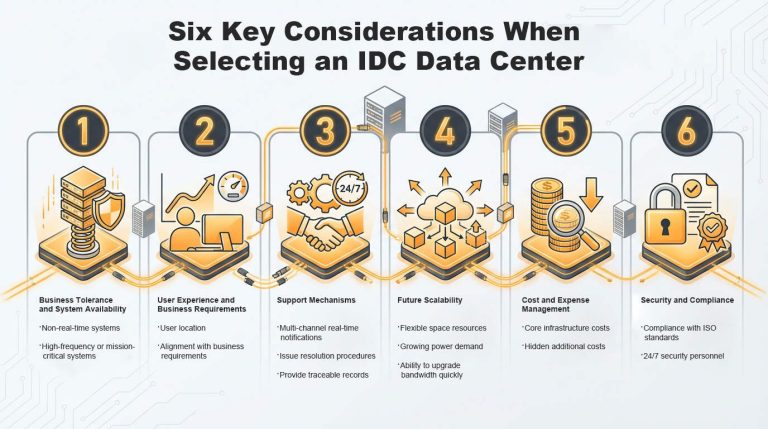
When selecting an IDC provider, Tier level is only one factor. Businesses should also evaluate cost, support capabilities, and future scalability to ensure the solution truly fits their needs.
Key Considerations for Choosing an IDC Data Center:
1. Business Tolerance and System Availability
Before choosing an IDC service, assess how much downtime your systems can tolerate:
- Non-real-time systems: If your system uses asynchronous backups and allows scheduled downtime, a more flexible and cost-effective option may suffice.
- Mission-critical systems: For systems like financial transactions, downtime can cause significant loss. High-availability infrastructure with real-time redundancy and low-latency networks is essential.
2. User Experience and Business Needs
Beyond downtime, network performance directly impacts user experience:
- User location: Applications like real-time transactions or streaming are highly latency-sensitive. Choosing a data center close to your user base reduces latency.
- Business alignment: Infrastructure should match your operational needs—for example, cross-border e-commerce requires high-bandwidth connectivity, while multinational enterprises may need secure private networks.
3. Support and Incident Response
A reliable IDC provider should offer strong support mechanisms:
- Multi-channel alerts: Clear notification systems and escalation procedures during incidents
- Issue resolution process: Defined troubleshooting workflows and technical escalation paths
- Traceable records: Incident reports and logs for review and optimization
4. Future Scalability
Consider long-term growth when selecting an IDC:
- Space scalability: Can additional racks be provisioned nearby as your infrastructure grows?
- Power capacity: Can the facility support higher power demands (e.g., AI or big data workloads)?
- Bandwidth flexibility: Can network capacity be upgraded quickly as traffic increases?
5. Cost and Budget Control
Understanding pricing structure is critical:
- Core costs: Clarify how rack space, power, and bandwidth are charged. Some providers offer low base fees but high overage costs.
- Hidden fees: Installation, relocation, remote hands support, and maintenance services may incur additional charges over time.
6. Security and Compliance
Security and compliance are essential when selecting an IDC:
- International certifications: Standards such as ISO 27001 (information security), ISO 20000-1 (IT service management), ISO 9001 (quality management), and ISO 14001 (environmental management) indicate strong governance.
- 24/7 security: Strict access control, continuous monitoring, and routine patrols ensure facility safety.
Eliminate the Burden of Building Your Own IDC with OneAsia Colocation Services
By understanding what an IDC data center is, along with its Tier classifications and key selection criteria, businesses can make more informed investment decisions and focus resources on what truly drives growth.
For organizations looking to avoid the high costs and operational complexity of building their own data center, OneAsia’s colocation services offer a reliable alternative. With secure facilities, stable power and cooling systems, compliance with international standards, and 24/7 monitoring, OneAsia provides a scalable and resilient environment to support your business operations and long-term growth.
References:
- Uptime Institute –Tier Classification System
- Congressional Research Service (CRS) – Data Centers and Their Energy Consumption
- Digital Policy Office, HKSAR Government – Practice Guide on Data Centre Security