What Should You Consider When Choosing AI Compute Power Leasing? Understanding Cloud Compute Rental Models and Gaining High-Performance Computing Advantages

Blog / What Should You Consider When Choosing AI Compute Power Leasing? Understanding Cloud Compute Rental Models and Gaining High-Performance Computing Advantages

算力租賃

With the explosive growth of generative AI (Generative AI) such as ChatGPT and Gemini, enterprise demand for high-performance computing resources is increasing at an unprecedented pace. Across many industries, this has become a core consideration in IT investment and AI strategy planning. 

This article takes an in-depth look at how cloud compute power rental models work, how enterprises should evaluate AI compute leasing providers, and how this approach can help businesses gain a competitive edge in the AI race.

Why Are Enterprises Turning to AI Compute Power Leasing? Breaking Through the GPU Supply Shortage

全球算力短缺-算力租賃

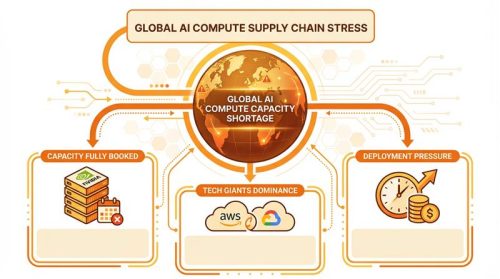
In the processes of AI model training and inference, “compute power” has become one of the three critical pillars alongside data and algorithms. However, the global market is currently facing a significant shortage of compute capacity:

  • Capacity Fully Booked: Leading chip manufacturer NVIDIA’s next-generation Blackwell high-end AI GPUs have been confirmed to be almost completely sold out in terms of production capacity through the end of 2025. [2]
  • Dominance by Tech Giants: Computing resources are primarily locked in by major technology companies such as AWS, Google, Microsoft, Meta, Amazon, and Oracle through large-scale advance orders. [2]
  • Deployment Pressure: Most enterprises are facing longer delivery lead times and higher costs in 2025, with high-end GPUs remaining in a state of persistent undersupply in the short term. [2]

Against this backdrop, AI compute power leasing has emerged as the preferred solution for enterprises. By adopting a “rent instead of buy” approach, organizations can alleviate the financial pressure of hardware procurement while avoiding lengthy hardware delivery cycles. This allows AI projects to be launched immediately, ensuring that R&D timelines are not delayed by supply chain bottlenecks.

What Is Compute Power Leasing? Why Has Compute Power Rental Become the Mainstream Model for AI Development?

In simple terms, compute power leasing refers to enterprises or individuals paying cloud service providers or compute centers for access to computing resources, primarily GPU compute power, rather than purchasing physical servers themselves. This model, often described as “GPU as a Service” (GPUaaS), focuses on delivering raw computing capability and GPU memory bandwidth, and is specifically designed for deep learning training and inference workloads. [3]

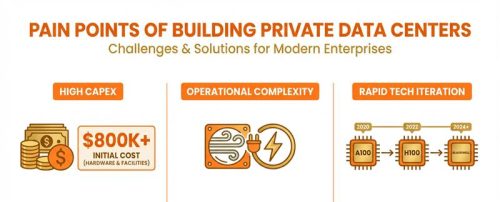
Beyond addressing supply shortages, cloud-based compute power rental has become mainstream because it resolves three major challenges associated with building and operating private data centers:

算力租賃解决數據中心痛點
  • High upfront capital expenditure (CAPEX): According to Lenovo analysis, the total cost of ownership (TCO) of an enterprise-grade server equipped with eight NVIDIA H100 GPUs is close to USD 800,000. Deploying a multi-node GPU cluster capable of supporting large-model training can easily push total costs beyond USD 1 million. [1]
  • Operational complexity: High-performance GPUs introduce challenges related to heat dissipation, power supply, and network latency. These require specialized data center infrastructure, including power redundancy, advanced cooling solutions, and high-bandwidth backbone networks. [4]
  • Rapid technology iteration: AI GPU generations evolve quickly. NVIDIA, for example, has moved from A100 and H100 to Blackwell B200 and GB200 within just a few years, often delivering multiple-fold performance improvements. Purchased equipment may become obsolete before it is fully depreciated. [2]

As a result, the cloud compute power rental model has emerged. It enables enterprises to access state-of-the-art computing resources on demand, converting large one-time capital expenditures (CAPEX) into flexible operating expenses (OPEX). This allows organizations to remain agile and focus their efforts on core business innovation. [1]

Advantages and Business Value of AI Compute Power Leasing

Choosing AI compute power leasing is not only about cost savings. It is also a strategic decision to improve operational efficiency. Below are the key advantages this model offers.

1. Flexibility and Elastic Scalability

AI projects typically follow clear phases. During the model training stage, demand for compute power reaches its peak. During inference or application deployment, demand is often more stable. [5]

With compute power leasing, enterprises can adjust the number of GPUs flexibly according to project progress. For example, hundreds of GPUs can be rented for several weeks during large language model (LLM) training. Once training is completed, resources can be released immediately, avoiding idle capacity and unnecessary waste. [3]

2. Immediate Access to the Latest Hardware Technologies

Hardware vendors continuously release more powerful computing chips. For enterprises that build and operate their own data centers, it is difficult to keep pace with these rapid hardware upgrades. Professional cloud compute power providers typically deploy the latest hardware as soon as it becomes available. This allows tenants to avoid concerns about hardware depreciation and consistently access highly efficient computing capabilities. For example, users can move quickly from A100 to H100 GPU clusters and upgrade directly within their rental plans to the latest platforms. [3]

3. Greater Focus on Core Business Innovation

Maintaining a high performance computing (HPC) environment requires dedicated IT teams to manage power supply, cooling systems, network architecture, and hardware failures. By adopting compute power leasing services, enterprises can offload these complex infrastructure operations to service providers. This allows internal data scientists and engineers to focus on algorithm optimization and model development, helping shorten time to market. [4]

Which Industries Require AI Compute Power Leasing Services?

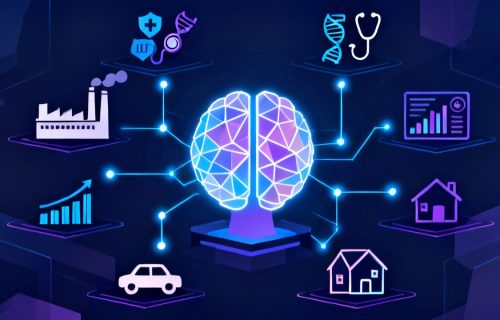
AI compute power leasing has become a critical tool for accelerating digital transformation and overcoming hardware cost barriers across industries. It is particularly valuable in sectors with extremely high demands for large-scale data processing and real-time computing. Leasing enables fast deployment and flexible scalability to achieve strategic objectives.:

  • Healthcare and Biotech: Tasks such as molecular modeling for drug discovery, protein folding simulations, and genome sequencing require very high GPU memory bandwidth. By renting cloud GPU resources, research teams can significantly shorten drug screening cycles and support high-precision medical image analysis, improving diagnostic accuracy.
  • Financial Services: Financial institutions process massive datasets for risk assessment, fraud detection, and complex algorithmic trading. Compute power leasing allows enterprises to flexibly scale GPU clusters during periods of market volatility or surging computational demand, releasing resources once tasks are completed, and optimizing operational costs.
  • Generative AI and SaaS Developers: Many startups and technical teams are developing proprietary large language models (LLMs) or image generation tools, which require extremely high compute power during the training phase. With high-end GPUs such as the H100 in short supply and expensive to procure, leasing allows developers to bypass long hardware delivery cycles and start projects immediately, focusing on algorithm optimization and innovation.
  • Autonomous Driving and Manufacturing: Autonomous driving relies on deep learning to analyze vast amounts of sensor data to optimize vehicle decision-making. Compute power leasing provides manufacturers with the high-performance environment needed to process massive amounts of road test data while avoiding the high capital costs of building and maintaining large AI-focused data centers.
  • Retail and E-commerce: Retailers use generative AI and machine learning for precise consumer behavior prediction, sentiment analysis, and highly personalized recommendation systems. Cloud compute leasing enables businesses to adjust computational resources flexibly according to traffic fluctuations during peak shopping periods, such as Singles’ Day or Black Friday, ensuring stable user experiences under high concurrency.

Types of Compute Power Leasing

算力租賃種類

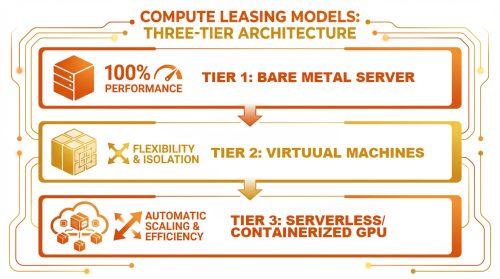
When selecting an AI compute power leasing service, enterprises should choose a model based on the scale of model training and the level of hardware control required. The main leasing models currently available in the market can be classified into three categories:

1. Bare Metal Server

Bare metal server leasing provides enterprises with direct access to physical servers. Its main feature is the complete removal of the virtualization layer, allowing GPUs to deliver 100% of their native compute performance. [3]

Because the entire server is dedicated to a single tenant, this leasing model eliminates resource contention issues, ensuring performance remains stable regardless of other users’ workloads. It is ideal for enterprise projects that require maximum compute stability, large-scale parallel training (such as full-parameter LLM training), and strict data privacy requirements. [9]

2. Virtual Machines

Virtualization technology partitions physical hardware resources, enabling enterprises to rent a specific number of GPU cores and memory more flexibly. [3] Virtual machines offer high scalability, fast startup times, and flexible deployment. They are particularly suitable for AI model inference, small to medium model fine-tuning, or early proof-of-concept projects, providing on-demand compute power at a lower barrier to entry. [8]

3. Serverless and Containerized GPU

This is a highly abstracted, on-demand model where developers simply deploy AI code or preconfigured AI environments (for example, using Docker) to the platform. The system automatically allocates and reclaims compute resources based on workload. [3]

The main advantage of this model is that there is no need to manage underlying infrastructure, and billing is based entirely on actual compute usage. It is highly cost-effective and convenient for non-continuous batch processing, temporary model testing, or lightweight AI application development. [8][9]

Factors to Consider When Choosing Cloud Compute Leasing Services

With many providers on the market—from large public clouds to vertical-focused GPU cloud services—enterprises need to evaluate cloud compute leasing solutions based on more than price. Key technical specifications and service commitments include:

1. Hardware Specifications and Cluster Performance

Not all GPUs are suitable for AI training. Enterprises should verify whether the GPU models provided by the vendor meet model requirements, such as memory size and FP16/FP32 compute capabilities. More importantly, cluster performance must be considered. [5] Training large AI models often requires multi-GPU and multi-node parallelism, making interconnect bandwidth between GPUs, such as NVLink or InfiniBand, critical. Low-latency, high-bandwidth network architectures ensure efficient collaboration between multiple GPUs and prevent communication bottlenecks from slowing training.

2. Data Center Infrastructure Standards

AI computing generates significant heat and demands high power density. Traditional data centers may not handle the cooling needs of high-density GPU servers. When evaluating compute leasing partners, enterprises should check whether their data centers are “AI ready.” This includes high-power-density rack design, stable and redundant power systems, advanced cooling technologies such as liquid cooling to support high-power GPUs, and compliance with Tier 3 or higher reliability standards. These measures ensure training processes are not interrupted by power outages or overheating. [6]

Further reading: What is an AI-Ready Data Center?

3. Data Security and Privacy Compliance

For industries such as finance, healthcare, or government, data privacy is a top priority. When using cloud compute leasing, enterprises must clarify the data storage location (data residency) and the encryption methods applied during data transfer. Companies should prioritize providers with multiple security certifications, such as ISO 27001, and those compliant with local regulations. Some may even consider leasing solutions based on private or hybrid cloud architectures to ensure the security of critical data assets. [7]

4. Pricing Models and Cost-Effectiveness

Different compute leasing models correspond to different cost structures. Enterprises should choose the most suitable combination based on project requirements, such as urgency and budget, rather than simply pursuing the lowest price. Common models include: [8]

ModelCharacteristicsSuitable Scenarios
On-DemandCan be started and stopped at any time, but unit cost is relatively highProof of concept tests, short-term trials, or projects with fluctuating demand
ReservedLong-term commitment with significant price discountsProjects requiring advance reservation of resources or long-running AI model training
Spot / Idle ResourcesTemporarily unused compute resources offered at the lowest cost; may be reclaimed by the system when demand risesNon-critical tasks with high fault tolerance, where interruptions do not affect the final outcome, such as data cleaning or non-core model fine-tuning

Delivering a High-Performance Computing Experience for the AI Era

In the AI era, compute power equals productivity. For most enterprises, building a large-scale compute infrastructure in-house is neither cost-effective nor practical. By leveraging professional compute leasing services, organizations can access top-tier computing resources more quickly and at lower cost, allowing them to focus on algorithm innovation and business applications. [9]

OneAsia is dedicated to providing enterprises with world-class digital infrastructure. Our AI-ready data centers feature high-density power supply and advanced liquid-cooling technology, ensuring the stable operation of high-end GPU clusters. We help you meet demanding AI compute leasing requirements with ease. Whether you need flexible cloud resources or managed AI servers, OneAsia delivers secure, reliable, and high-performance solutions tailored to your needs.

What Cybersecurity Risks Are Associated with Generative AI? An Overview of AI Data Security and Protection Methods

Blog / What Cybersecurity Risks Are Associated with Generative AI? An Overview of AI Data Security and Protection Methods

生成式AI資安風險示意圖

Have you ever considered that when you interact with an AI agent, the system may be learning your personal information while collecting and analyzing sensitive data that should be protected? The security risks hidden in the use of generative AI affect more than personal privacy. They may also impact business operations and regulatory responsibilities, making them a major topic in today’s AI security landscape.

This article from OneAsia walks you through the data security issues that may arise when applying AI and introduces protection methods so you can enjoy the convenience of AI while safeguarding your information.

What Are the Cybersecurity Risks of Generative AI?

According to a 2025 survey by the Hong Kong Office of the Privacy Commissioner for Personal Data (PCPD) involving 60 local organizations, 80% of the surveyed entities already use AI in their operations. Among them, 50% collect and use personal data through AI systems [1]. This shows that AI data security has become a critical concern in business operations.

Generative AI cybersecurity risks refer to the various security threats that can occur during the development, deployment and use of AI systems. Examples include prompt injection attacks that trick AI into revealing sensitive information, malicious attempts to modify model code, or manipulations that cause incorrect output. Since generative AI relies on continuous learning and model optimization, its decision-making process is often opaque and complex. This means sensitive data must be protected during training, while ensuring model integrity and overall system security.

Categories of Cybersecurity Risks in Generative AI

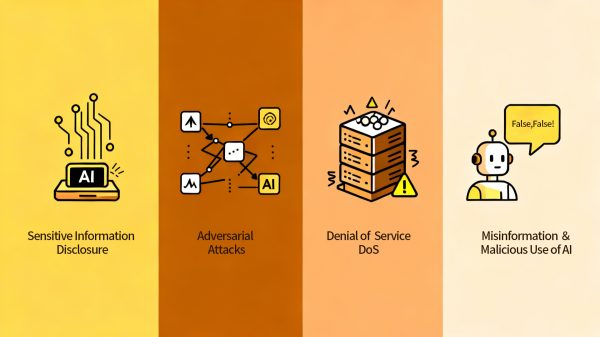
As generative AI evolves, international organizations have proposed different risk classifications, including NIST, OWASP, MITRE ATLAS and ENISA. Summarizing these perspectives, the cybersecurity risks of generative AI can be grouped into four major categories:

Sensitive Information Disclosure

Sensitive information disclosure is one of the most common AI security risks. It refers to unauthorized access, theft or exposure of private data such as personal identity information, medical records, financial details or corporate secrets.

In generative AI systems, these risks may originate from improper handling of training data or vulnerabilities within the system itself.

Adversarial Attacks

Adversarial attacks are another core risk in generative AI. Attackers may manipulate data or input malicious content that causes the AI model to misjudge or reveal sensitive information. Based on the MITRE ATLAS framework [2], common types of attacks include:

  • Adversarial Examples: Small and almost undetectable changes to inputs that cause the model to make incorrect decisions. This includes subtle alterations to image pixels, audio waveforms or text.
  • Prompt Injection: Embedding malicious instructions into input prompts or external resources to induce the model to violate its rules or expose private information.
  • Data Poisoning: Injecting incorrect or malicious data during training or fine-tuning to damage the model’s accuracy and stability.
  • Model Extraction/Theft: Repeatedly querying a model to collect input-output pairs, which an attacker can use to train a substitute model. If a company outsources AI model development to an unauthorized party, this may result in data security issues or even intellectual property loss.
  • Model Inversion: Using model responses to infer the characteristics of training data and reconstruct private information.

Service Disruption (Denial of Service, DoS)

Generative AI requires significant computational resources for inference and training, including GPUs, network bandwidth and cloud infrastructure. Malicious or unexpected attacks may overwhelm these resources, causing degraded performance or complete service outages. This makes service disruption one of the most serious risks affecting operational stability. Common causes include:

  • Query Flooding: Attackers send excessive requests, overloading the model and slowing or halting responses.
  • API Abuse: Many generative AI systems are offered through APIs. Weak authentication can allow automated scripts to make large-scale calls, draining resources.
  • Infrastructure Overload: In cloud or shared computing environments, attacks on CPU, memory or network bandwidth can push the system to its limits, preventing it from responding normally.
  • Dependency or Supply-chain Attacks: Attacks targeting external platforms that AI models rely on, such as cloud providers, key management systems, third-party components or open-source packages. This can indirectly disrupt AI services and threaten the data security of companies that use AI in their operations.

Further reading: Infrastructure for Software Services: Understanding Cloud Service Models and Cloud Computing Deployment Models

Misinformation &Malicious Use of AI

Generative AI also brings risks related to fraud. In 2024, a widely reported case in Hong Kong involved an employee of a multinational company who was deceived during a video conference. Scammers used AI deepfake technology to fabricate both the visuals and the voice of senior staff, leading the employee to believe the instructions were legitimate. As a result, over HKD 200 million was transferred to multiple bank accounts.

This case highlights that beyond data leakage risks, generative AI may also be misused to create false information and content, potentially causing financial and operational damage.

Differences Between Traditional Cybersecurity Risks and AI Cybersecurity Risks

CategoryTraditional Cybersecurity RisksAI Cybersecurity Risks
Attack targetNetworks, databases and other conventional system resourcesThe AI model itself, training data and generated content
Predictability of behaviorBased on clear rules and easier to detectModels learn and optimize, creating uncertainty in behavior
Nature of data sourcesUsually structured attacks with identifiable originsLarge volumes of unstructured data with complex and varied sources
Scope of attackOften focused on firewalls and network perimetersModel APIs, third party models and external data sources

Since traditional cybersecurity risks focus mainly on system and network protection, and generative AI risks involve models, data and algorithms across multiple layers, the potential attack surface becomes wider and the impact more difficult to predict. Safeguarding AI data security therefore requires more than strengthening infrastructure. It also needs to cover controls for model training processes, the use of third party models and the security of external resources.

AI Data Security and Protection Strategies

AI資料安全及防護策略示意圖

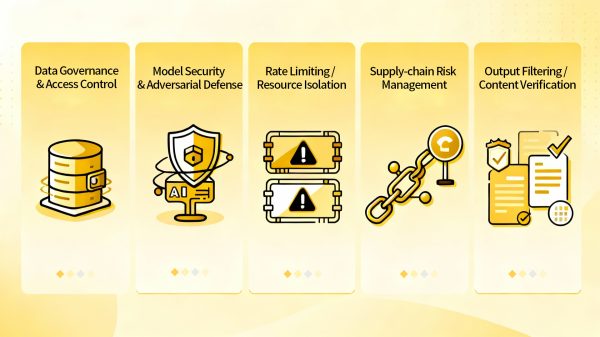
To address the various cybersecurity risks associated with generative AI, it is recommended to adopt a layered protection approach that enhances overall data and system security.

Data Governance & Access Control

Enterprises should classify and label different types of data (such as personal information, confidential business data and training datasets) and establish a clear authorization framework that ensures only permitted personnel can access or modify critical information. Measures such as encryption, secure transmission protocols like TLS/SSL and data access audit mechanisms should be implemented to prevent unauthorized access or data leakage.

Model Security & Adversarial Defense

To prevent the AI model from being misled or manipulated into making incorrect decisions, organizations should regularly test how the model performs when exposed to abnormal or malicious inputs. Early detection of vulnerabilities helps maintain AI data security. A continuous monitoring system should also be in place to track model behavior in real time and correct anomalies promptly.

Rate Limiting and Resource Isolation

Setting traffic limits and applying resource isolation helps reduce the risk of models being overwhelmed by high frequency queries or large scale API calls. Enterprises can define request limits based on user identity, use case or risk level, and deploy load balancing and abnormal traffic monitoring mechanisms to avoid service instability or security incidents.

Supply Chain and Third Party Risk Management

Modern AI systems often follow an agentic architecture that integrates external tools and third party services. All related resources require thorough security assessment. Regular checks on cloud platforms, open source components and third party packages help ensure compliance and prevent external threats from impacting core systems.

Further reading: What Are AI Agents? Understanding Their Analytical Capabilities and Applications

Output Filtering and Content Verification

A significant portion of generative AI risks arises from the model’s ability to create misleading or malicious content. To mitigate this, organizations should implement content filtering, output moderation and fact verification mechanisms to protect against misinformation and fraud. It is also recommended that any AI generated content be clearly labeled as such, allowing users to recognize the source of information.

Protecting AI Systems by Choosing a Trusted Platform

守護AI系統安全示意圖

Generative AI introduces risks such as data leakage, model attacks, service outages and content abuse. Any of these can have long term effects on business operations and brand reputation. To strengthen AI data security, organizations should combine governance, technical safeguards and secure platforms through clear data management policies and reliable protection technologies.

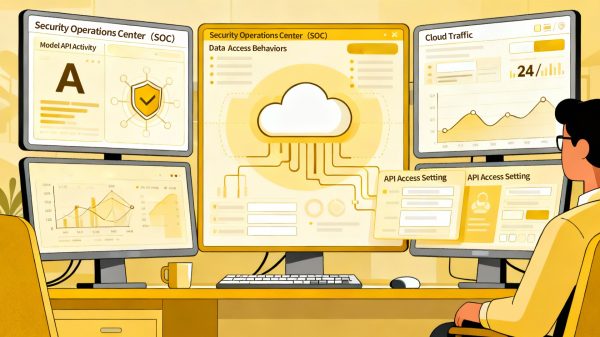
OneAsia’s Security Operations Center (SOC) provides round the clock monitoring for AI systems, including model APIs, data access activities and cloud traffic. The SOC detects abnormal requests and potential attacks. Our cloud management service centralizes the management of AI applications and data, covering user permissions, encryption measures and API access controls. This ensures secure and traceable data transmission while effectively allocating computing resources to prevent service interruptions caused by high traffic or model workloads.

If you have any questions about secure AI deployment, feel free to contact OneAsia. We can help you build an AI ready infrastructure tailored for your organization.

What Are AI Agents? Understanding Their Analytical Capabilities and Applications

Blog / What Are AI Agents? Understanding Their Analytical Capabilities and Applications

ai代理是什麼-ai代理人-應用-分析

Have you come across the term “AI Agent” on social media or in tech news and wondered how artificial intelligence can autonomously handle complex tasks? More intriguingly, how can AI agents analyze data and make decisions without direct human supervision?

In this article, OneAsia takes you through what AI agents are, how they work in practice, and the key technologies behind them. By understanding their core principles and distinctions, you’ll gain a comprehensive view of this emerging field, and how AI agents are shaping the future across industries.

What Is an AI Agent? A Look at Its Core Mechanisms

什麼是 AI 代理?

AI agent is an intelligent system capable of autonomous perception, decision-making, and execution. Within a given environment, it can analyze information, devise strategies, and carry out actions, which marks a major step toward self-directed AI.

Think of a virtual assistant that proactively checks your schedule, reminds you of meetings, and automatically adjusts appointments when something unexpected occurs. An AI agent functions in a similar way: it coordinates strategies, learns continuously, and improves collaboration accuracy over time.
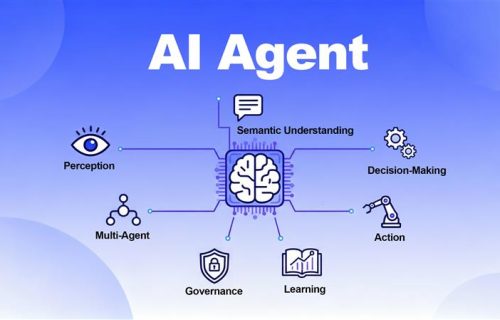
From a technical perspective, an AI agent can be broken down into seven key components:

1. Perception

Through environmental sensing, an AI agent leverages large language models (LLMs) as its “intelligent core,” similar to how the human brain processes information. It can understand language and commands while integrating data from various sources, such as sensors, APIs, or databases to gain context and structure for more advanced decision-making.

2. Semantic Understanding & Goal Encoding

Using an LLM as its foundation, the AI agent interprets the meaning and intent behind input data, then translates those insights into actionable objectives. This allows it to break down tasks, allocate resources efficiently, and plan subsequent actions.

3. Decision-making & Planning

At its heart, an AI agent specializes in autonomous planning and task decomposition. Through machine learning, deep learning, and algorithmic modeling, it analyzes the task environment, divides complex goals into smaller subtasks, and computes optimal solutions. With real-time updates from the perception phase, the agent dynamically refines its strategies and decisions.

4. Action & Integration

Beyond passive responses, AI agents can actively initiate actions via external system APIs, such as retrieving online information, sending emails, or assigning tasks. Today’s agents already integrate seamlessly with enterprise systems like ERP and CRM, enabling smooth cross-platform collaboration and efficient workflow execution in dynamic environments.

5. Learning & Feedback

“Learning from the past to improve the future” captures the essence of AI agent optimization. By continuously reviewing historical data and user feedback, the agent identifies valuable patterns, updates its models, and enhances future task performance, creating a continuous improvement loop.

6. Governance & Sercurity

To ensure safe, compliant, and controllable operation, governance and security are critical. AI agents must verify that their data sources meet legal and ethical standards and comply with privacy and enterprise policies. Since agents often have high-level system permissions, multi-layer authentication and access controls are essential to prevent breaches and maintain data integrity.

7. Multi-Agent Systems (MAS)

Advanced AI frameworks support multi-agent collaboration, where several agents can share data, divide tasks, and make coordinated decisions in real time. These systems allow agents to communicate and assist each other, working together to solve large and complex challenges. This level of coordination forms the foundation of enterprise-level AI ecosystems that are connected, adaptive, and intelligent.

AI Agents vs. Agentic AI

AI代理人與代理式AI的差異

Now that we understand how AI agents work, let’s distinguish between AI agents and Agentic AI.

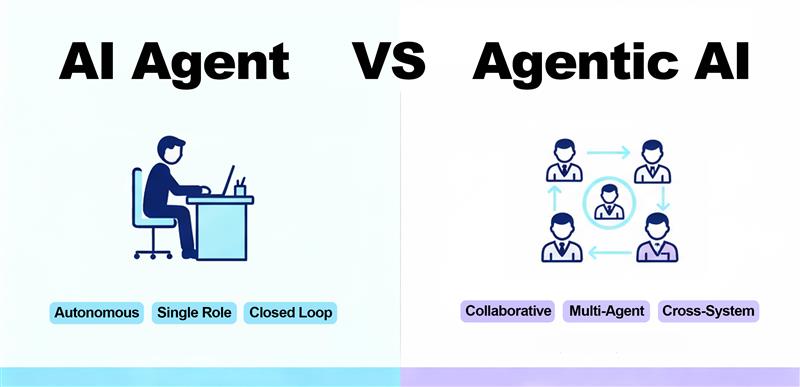
An AI agent typically refers to a self-contained intelligent entity capable of completing the full cycle of perception, decision-making, action, and learning autonomously, operating as a standalone unit.

In contrast, Agentic AI is a system-level architecture — a coordinated network of multiple agents and external tools working together. It focuses on multi-stage task planning and collaborative execution, integrating diverse systems to tackle more complex scenarios.

Comparison Between AI Agents and Agentic AI:

CategoryAI AgentAgentic AI
DefinitionA single intelligent technology capable of the full cycle of perception → decision-making → action → learningA system-level architecture that integrates external tools and coordinates multiple agents
Key CharacteristicsStrong autonomy, capable of independently completing specific or bounded tasksTask-oriented, emphasizing cross-system integration and collaboration
Scope of OperationFunctions as an individual roleOperates across end-to-end workflows through multi-agent cooperation
Enterprise AnalogyA personal assistantAn entire administrative office (e.g., accounting, HR, finance)

AI Agent Use Cases and Applications

AI代理範例與應用

AI agents can analyze, perceive, learn, and make independent decisions. They are also able to adjust their strategies in response to changing environments, which makes them highly effective in fields that require flexibility and intelligent judgment.

Agentic AI, in turn, extends these capabilities by connecting AI agents with external tools and systems, enabling cross-platform collaboration and handling more complex, multidimensional tasks.

Below are some common examples showcasing how both AI agents and Agentic AI are applied across industries:

Examples of AI Agents:

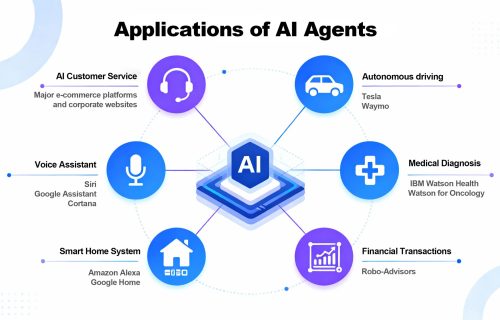
  • Smart Customer Service Bots: Intelligent customer service agents can automatically respond to inquiries, provide real-time assistance, and guide users — a common feature across major e-commerce platforms and enterprise websites. Leveraging natural language processing (NLP), these agents understand customer intent and deliver accurate, context-based responses.


  • Autonomous Driving Systems: Companies like Tesla and Waymo use AI agent technology at the core of their self-driving systems. By analyzing data from sensors and cameras, these agents perceive surroundings, make split-second decisions, and enable fully autonomous driving.


  • Medical Diagnostic Assistance: In healthcare, AI agents are often used for analyzing patient records or interpreting medical images to assist doctors in diagnosis and treatment planning. A well-known example is IBM Watson Health, whose Watson for Oncology applies NLP to analyze patient data and medical literature, supporting oncologists in developing personalized treatment strategies.

Examples of Agentic AI:

  • AI Voice Assistants: Applications like Siri, Google Assistant, and Cortana exemplify AI agents capable of understanding spoken commands, performing real-time searches, setting reminders, sending messages, and more. Over time, they learn user habits and preferences, improving their responsiveness and contextual accuracy.


  • Smart Home Ecosystems: Solutions such as Amazon Alexa and Google Home integrate AI agent technology with external tools to manage smart devices — from lighting and speakers to curtains. Through automation rules and voice control, they can, for example, turn on the air conditioner and lights when a user arrives home, enhancing convenience and comfort.


  • Financial Trading and Investment Advisory: In finance, Agentic AI systems like Robo-Advisors employ cross-system data analysis to recommend investment strategies. They automatically identify promising assets, design optimal portfolio allocations, and use quantitative models and time-series analysis to interpret market data (such as interest and exchange rates), helping investors reach their financial goals.


  • Cybersecurity Protection: Agentic AI also plays a crucial role in cybersecurity. Automated threat detection and response systems can identify and react to attacks in real time to safeguard corporate data. For instance, UK-based Darktrace uses its “self-defending AI agent” Antigena, which autonomously isolates affected networks, enforces firewall rules, and restricts abnormal traffic once threats are detected.

The Future of AI Agents

As technology evolves, AI agents are no longer just auxiliary tools, they are reshaping how entire industries operate. From autonomous vehicles to intelligent customer service, AI agents are increasingly integrated into our daily work and life.

By understanding what AI agents are, their analytical frameworks, and how Agentic AI extends these capabilities, organizations can harness such technologies to streamline workflows and boost productivity.

If you’re looking to build your own AI agent system, OneAsia offers enterprise-grade data center hosting and computing services to help you deploy models efficiently, handle computation-intensive tasks, and dynamically scale processing power to support AI training, inference, and decision-making.

We also provide cloud services, known as cloud computing that automatically manage and adjust cloud resources based on your AI agent’s needs. When integrating multiple systems or managing large-scale cloud workloads, OneAsia’s cloud computing infrastructure ensures flexibility, scalability, and reliable support for AI agent deployment and operations.

As the technology continues to advance, AI agents are expected to create even greater value across industries by enhancing efficiency, minimizing human error, and inspiring new models of service and innovation.

To learn more about the latest developments in AI and our managed service offerings, contact OneAsia today.

Infrastructure for Software Services: Understanding Cloud Service Models and Cloud Computing Deployment Models

Blog / Infrastructure for Software Services: Understanding Cloud Service Models and Cloud Computing Deployment Models

雲端運算封面圖

Digital transformation has become a critical factor in enhancing corporate competitiveness in today’s world. How can businesses leverage the right and efficient cloud deployment models to adapt to market changes? 

First, it is essential to understand the various cloud service models and the differences in cloud computing architectures. By planning a suitable framework tailored to the organization’s specific needs, businesses can maximize the benefits. OneAsia will guide you through the distinctions and practical applications of these cloud computing deployment models.

Three Major Cloud Service Models: IaaS, PaaS, SaaS

三大雲端服務模式:laaS、PaaS、SaaS

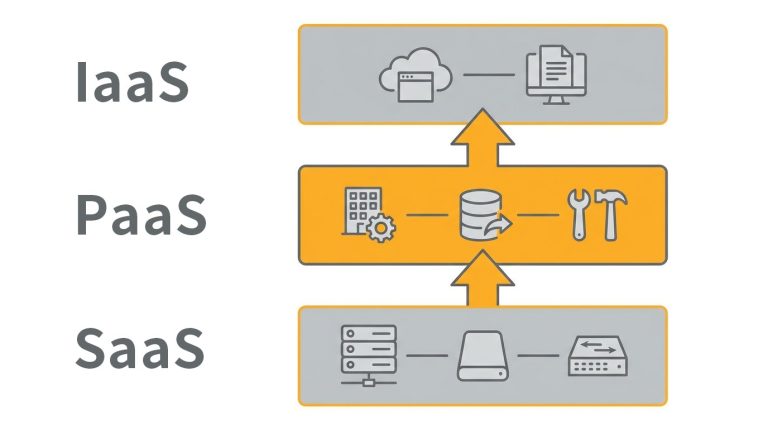
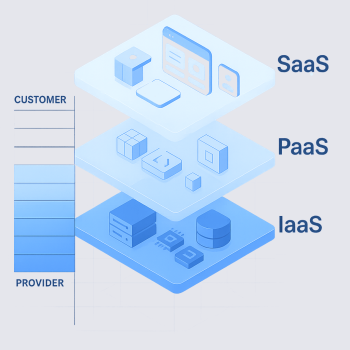
IaaS(Infrastructure as a Service)

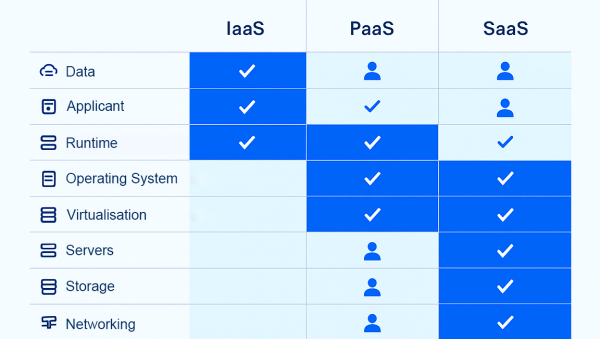
IaaS primarily provides customers with virtualized computing resources, such as virtual machines (VMs), virtual disks, cloud storage, virtual networks, and firewalls. Users can leverage this cloud service model to build or protect their data. Common applications include renting virtual servers in the cloud for website hosting and system testing. IaaS offers highly flexible storage capacity and system control permissions. Tenants can dynamically adjust their resource allocations to match evolving usage demands.

PaaS(Platform as a Service)

PaaS represents a service mechanism where the platform itself is delivered as a service, providing users with a complete cloud service model. Supported components typically include cloud computing power, server operations, database management systems, and application development tools, enabling developers to focus on the development process and application deployment. This cloud computing model eliminates the need for underlying infrastructure construction or self-hosted servers. Developers can instantly integrate with their company’s cloud deployment model (public, private, or hybrid cloud) on the provided online platform to manage critical data, perform software development, and execute data transfers.

SaaS(Software as a Service)

SaaS, as the name implies, allows users to operate applications via a browser or downloaded software without needing to build servers, implement technical infrastructure, or maintain operating systems. Service providers handle server management, system updates, and related tasks. SaaS also supports cross-device synchronization. Users simply download the same software on different devices and log in to their account to enable data sharing and seamless workflow continuity, regardless of location or time.

Which Cloud Service Model Suits You Best? A Comparison of Three Service Models

After understanding the three cloud service models, how do enterprises determine which one is suitable for their business? Each model varies in deployment based on enterprise needs. Below are the three cloud service models and their applicable scenarios.

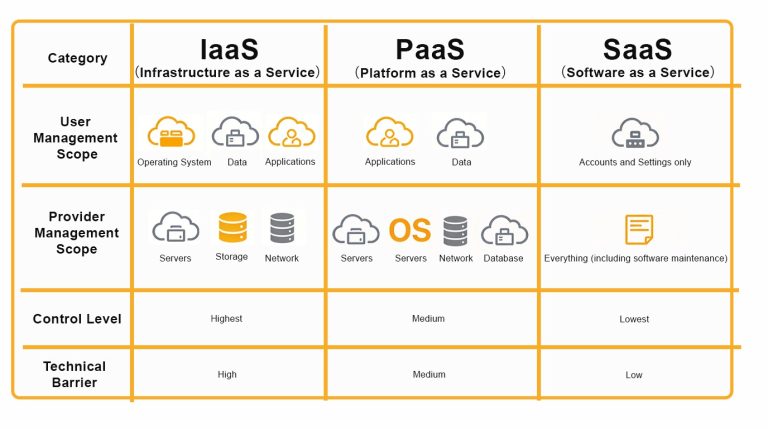
三種雲端服務模式比較圖表

IaaS Use Cases and Advantages

IaaS has higher technical requirements compared to the other two models, typically requiring specialized technicians to assist with operating system installation, system application deployment, and network configuration. However, IaaS offers users high flexibility, including various virtualized resources (VMs, servers, cloud storage). This allows users to dynamically adjust resource leasing based on their own usage needs, to realize a pay-as-you-go model.

This cloud service model also offers rapid deployment and global scalability, enabling swift provisioning of resources based on business needs. Service providers leverage globally located data centers to deploy systems according to target market locations or optimize cloud deployment models by analyzing end-user geographic distribution and usage patterns, thereby enhancing customer experience. IaaS is suitable not only for SMEs and startups but also for growing enterprises and multinational corporations.

PaaS Use Cases and Advantages

Since PaaS requires no self-built development platforms, nor underlying server management or network configuration, it can save startups significant time and technical resources that would otherwise be spent on building infrastructure. This accelerates development progress and avoids the need for large technical teams for backend maintenance. For instance, this cloud service model is frequently used in online learning platforms, allowing teams to focus on course design, content creation, and service delivery.

SaaS Use Cases and Advantages

SaaS also has the advantages of no installation or system setup required, making it ideal for remote work or multinational teams. Users simply need internet access and can start using the service by clicking to log in to the software. This cloud-based system deployment model is widely used for applications like Customer Relationship Management (CRM), customer service systems, or cloud file storage systems such as Dropbox. It enables greater efficiency in internal collaboration, project management, and document sharing within enterprises. Furthermore, this cloud service model is highly suitable for real-time online meetings during work. Common meeting platforms like Google Meet and Microsoft Teams support instant voice and video conferencing, enhancing communication efficiency for remote workers and accelerating workflow processes.

Comparison Table of Three Cloud Service Models

IaaSPaaSSaaS
Scope of ServicesVirtual machines, cloud storageAPI, platform development, databaseApplications (CRM, ERP)
Target UsersIT personnel, system administratorsDevelopers, engineering teamsGeneral users, business professionals
AdvantagesHighly flexible and customizableRapid development, maintenance-fee serversQuick setup, no technical background required

What Are the Cloud Computing Deployment Models?

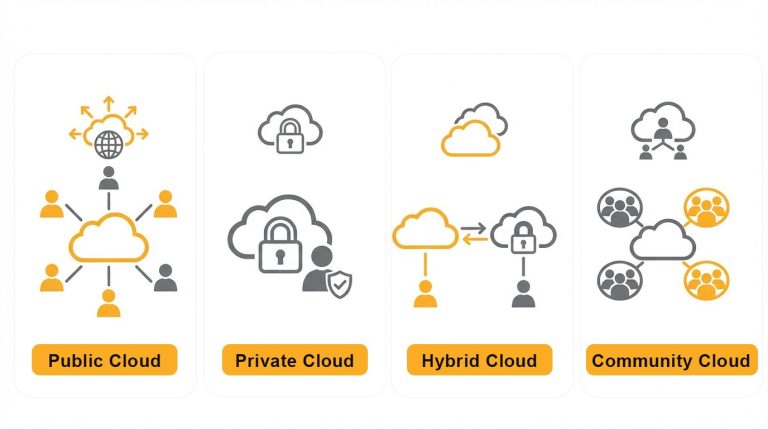
雲端部署模式示意圖

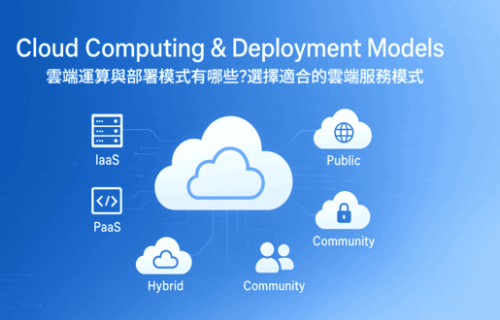
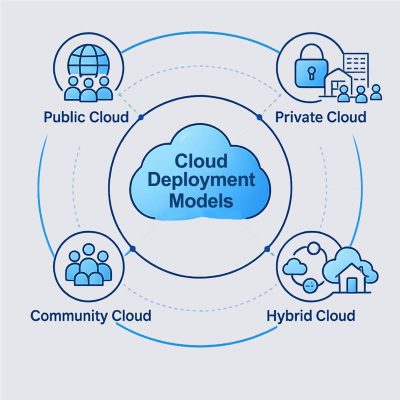
Unlike cloud services, which primarily concern the level and form of service content, cloud computing’s “deployment models” focus on data access methods, security, as well as the construction and usage types of cloud environments. Selecting the appropriate model is the primary factor in planning an enterprise’s digital transformation. Different models each possess unique characteristics and advantages. Below are explanations of several common cloud computing deployment models and solutions:

Public Cloud

This model relies on third-party providers, so enterprises do not need their own data centers to manage data. It suits companies seeking high flexibility and scalability. Well-known examples like Google Cloud, AWS, and Microsoft Azure fall under this cloud computing deployment model.

Private Cloud

Resources are not shared with any external parties. Typically deployed within the enterprise’s own premises for data access and storage, it offers higher security and controllability. Commonly adopted in the healthcare industry or by organizations with stringent requirements for personal or user privacy data.

Hybrid Cloud

It combines elements of both public cloud and private cloud. Enterprises can configure it according to their needs, keeping sensitive and private data within the private cloud for enhanced security. Meanwhile, data intended for user sharing or API integration can reside in the public cloud, enabling convenient access and connection to databases and various library resources. Hybrid clouds offer flexibility in data management while ensuring the security of private data.

Community Cloud

Community Cloud is a deployment model suitable for organizations with shared requirements to jointly own and manage resources. Data within this kind of cloud is restricted to members of the community through permissions.

Cloud Computing Deployment Models and Colocation: OneAsia is Your Top Choice

OneAsia雲端運算部署模式與託管

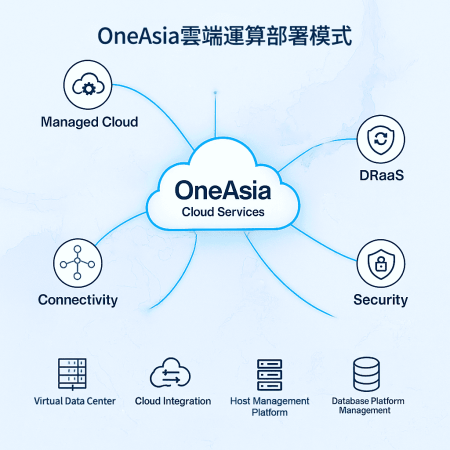
The difference in cloud computing models is determined by who manages which aspects, which elements require technical support, and which require maintenance by the enterprise itself. To address the diverse scenarios and applicability of the aforementioned cloud deployment models, OneAsia offers a comprehensive cloud service offering, including one-stop cloud service hosting, professional technical support teams, and network connectivity services. Regarding information security, we adhere to international information security standards, deploy intrusion detection systems, and conduct regular security audits to safeguard the privacy and confidentiality of client data.

OneAsia’s IaaS cloud service model saves business from the expense of building its own server room and expensive hardware resources, with services that include:

  • Virtual Data Center: Provides enterprises with high autonomy to manage virtual machines (VMs), along with subscription services for data storage space, network resource allocation, and other resources required by the enterprise.
  • Highly elastic computing resources: Scalable to accommodate business growth, users need not worry about resource shortages or limitations arising from business expansion or increased user numbers.
  • Data Center Colocation and Cloud Integration: With robust information security protection and centralized data center hosting, users can easily and quickly access and categorize data. Cloud integration combines multiple cloud deployment models, enabling the IaaS architecture to achieve flexible hybrid cloud environments.

In addition, OneAsia also provides a range of platform-level technical services to help organizations save manpower for cloud computing deployment during the development process, streamline IT operations, and focus on delivering value-added services and driving innovation. In terms of PaaS, OneAsia offers:

  • Server Management Platform: Enables users to install application servers such as Web Servers or Database Servers, supporting rapid deployment of cloud computing models tailored to your enterprise needs.
  • Database Platform Management: Highly secure database management delivering robust data protection measures, ideal for enterprises or government agencies with specific data management requirements. Enhances efficient public services and shared services while offering flexible scalability and stringent access control mechanisms.

If you have questions or requirements regarding cloud service models or other enterprise cloud deployments, contact OneAsia to learn more about our services. We tailor solutions to your specific needs, helping you advance toward smart operations and enterprise digital transformation. We also assist in effectively managing IT resources while integrating with existing infrastructure for cost optimization.

References:

https://www.techtarget.com/searchcloudcomputing/definition/Software-as-a-Service

https://azure.microsoft.com/en-us/resources/cloud-computing-dictionary/what-is-saas

https://www.techtarget.com/searchcloudcomputing/definition/Platform-as-a-Service-PaaS

https://www.proofpoint.com/us/threat-reference/infrastructure-as-a-service-iaas

https://www.ibm.com/cn-zh/think/topics/iaas-paas-saas

Understanding Hybrid Cloud Architecture: Benefits and Examples of Hybrid Cloud Architecture for Enterprises

Blog / Understanding Hybrid Cloud Architecture: Benefits and Examples of Hybrid Cloud Architecture for Enterprises

混合雲架構簡單說明圖

With the accelerated digital transformation around the world, enterprises are facing increasingly diverse and complex IT infrastructure requirements. Hybrid Cloud is a new solution that combines public and private clouds to enhance the flexibility and security of digital utilization. The following is an in-depth analysis of the Hybrid Cloud architecture and advantages, and illustrates the application of Hybrid Cloud with examples, explaining how Hybrid Cloud can help enterprises to enter into a higher-end digital transformation and optimize the allocation of enterprise resources.

Understanding the Fundamentals of Hybrid Cloud: Public Cloud vs. Private Cloud

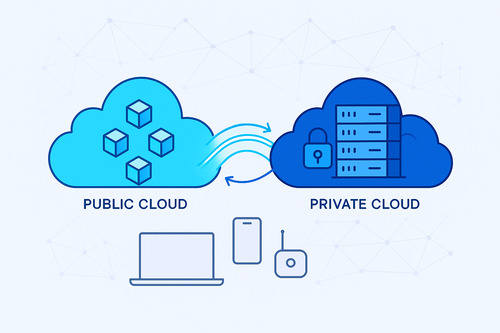
混合雲的基礎:公有雲和私有雲的分別

Private Cloud

A private cloud is a cloud environment designed exclusively for a single enterprise or organization. All resources are reserved for internal use and are not shared with external users. The infrastructure of a private cloud can be deployed within the enterprise’s own data center or built and hosted by a third party specifically for that enterprise. Private clouds emphasize high data security and privacy while offering full autonomy and control. Enterprises can configure resources, manage permissions, and customize systems according to their specific needs, making them particularly suitable for industries with stringent requirements for data protection, compliance, and service stability. However, the construction and maintenance costs of private clouds are relatively high, requiring IT departments to shoulder greater management and maintenance responsibilities.

Public Cloud

Public cloud refers to a cloud model where third-party providers deliver various cloud resources and services to all enterprises or individual users via the internet. Public cloud resources are extremely abundant, including virtual machines (VMs), computing power, data storage, networking, and diverse applications. All users access these resources in real-time over the internet and pay based on actual usage. The infrastructure and hardware of public clouds are built, managed, and maintained by the cloud service provider. Users do not need to invest in or maintain IT hardware themselves, significantly reducing initial costs and operational burdens. As public clouds operate on a multi-tenant architecture where resources are shared among multiple users, they are well-suited for businesses requiring flexible scalability, cost sensitivity, or rapid deployment.

What is a hybrid cloud architecture?

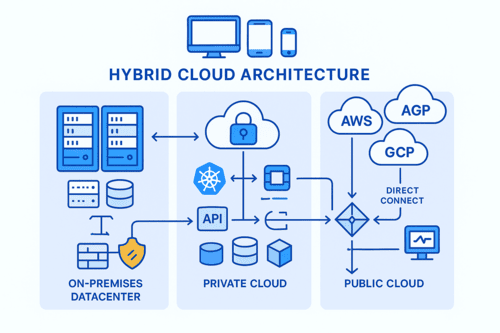
混合雲詳細架構圖片,說明整合與協同運作的原理

A hybrid cloud architecture is an IT environment that strategically integrates and coordinates an enterprise’s private cloud with the services and resources of one or more public clouds. Under this architecture, enterprises distribute applications, workloads, and data across the most suitable cloud environments based on their specific characteristics. Simultaneously, they leverage the elasticity and scalability of public clouds to handle sudden traffic spikes or large-scale computational demands. This architecture enables enterprises to flexibly allocate resources according to varying business demands, achieving optimal cost-effectiveness and operational efficiency.

The core of hybrid cloud architecture lies in “seamless integration”—internal data centers (private clouds) and external cloud services (public clouds) must collaborate through secure, efficient connectivity to ensure the smooth operation of data and applications.

Hybrid Cloud Advantages

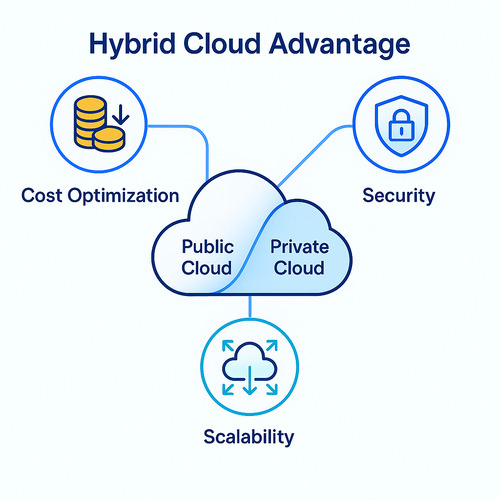
混合雲架構在成本控制、安全和規模彈性上的優勢

As enterprise IT environments grow increasingly complex, hybrid cloud solutions have become the mainstream choice. Compared to relying solely on private or public clouds, adopting a hybrid cloud approach offers the following advantages:

1. One-Stop Multi-Cloud Connectivity Service


The foundation of hybrid cloud architecture lies in securely and efficiently connecting internal enterprise data centers (private clouds) with external public cloud resources. Hybrid clouds typically offer multiple connection methods, such as private lines or VPNs, enabling enterprises to exchange data and collaborate across different cloud platforms. They also support flexible connections between multi-cloud environments and cloud-to-cloud scenarios. This one-stop connectivity significantly simplifies resource allocation and management, enhancing IT operational efficiency.

2. Cost Savings Through Flexible Hybrid Cloud Deployment Models


Hybrid clouds enable enterprises to deploy IT resources flexibly based on actual needs. For instance, companies can deploy sensitive data and critical applications on private clouds to ensure security and compliance, while migrating workloads with high computational demands or seasonal traffic to public clouds to benefit from elastic scalability and cost optimization. This flexible hybrid cloud model enables businesses to dynamically adjust resources based on real operational needs, avoiding waste from overprovisioning due to inaccurate forecasts. Long-term, this approach helps enterprises continuously enhance cost efficiency.

3. Professional Management and Security Assurance


Hybrid cloud security ranks among enterprises’ top concerns. Hybrid cloud solutions typically integrate multi-layered security technologies, including traffic encryption, access control, threat detection, and automated vulnerability assessment, ensuring secure data and application transmission and storage across diverse cloud environments. Additionally, unified management platforms provide cross-cloud resource monitoring, permission management, and compliance auditing, reducing management complexity and boosting IT team efficiency.

4. High-Performance Computing and Resource Flexibility


For enterprises requiring high-performance computing (such as AI, machine learning, or big data analytics), hybrid clouds offer flexible access to public cloud resources like GPUs. This enables on-demand scaling of computational power without the need to build expensive hardware infrastructure. This approach not only boosts computational efficiency but also optimizes budget allocation for businesses.

Practical Examples of Enterprise Hybrid Cloud Architecture

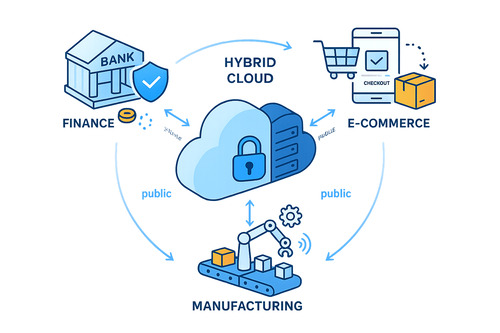
企業混合雲架構實際應用例子示例圖

Here are some examples of how companies across different industries leverage hybrid cloud to maximize its benefits:

Financial Services: Expanding Cloud Data Centers


Financial institutions can leverage hybrid cloud architectures to deploy core transaction systems on private clouds, ensuring data security and compliance. Simultaneously, customer behavior analysis and big data processing workloads can be placed on public clouds, utilizing their powerful computing capabilities to rapidly complete analyses and enhance decision-making efficiency.

E-commerce and Retail: Flexible Seasonal Traffic Management


During promotion and peak seasons, e-commerce companies can rapidly scale public cloud resources via hybrid cloud to handle traffic surges and prevent website crashes. Routine operations primarily run on private clouds during off-peak periods, optimizing cost efficiency.

Manufacturing: Secure Data Backup Solutions


Manufacturing enterprises, for instance, leverage hybrid cloud architectures to back up core production system data to public clouds as secure backup solutions. This ensures rapid restoration of production system operations during local data center (private cloud) failures, further safeguarding production system stability.

Higher Education Institutions: Research and Teaching Platform Support


Although higher education institutions are not enterprises, they can still take advantage of hybrid cloud architecture, such as deploying sensitive student data and academic systems in the private cloud to ensure data privacy. Universities can also deploy their research projects, simulation experiments or online learning platforms that require large amounts of computing resources in the public cloud, utilizing its flexible and scalable computing power to meet peak teaching and research needs, and paying for actual usage to effectively control costs.

Construction Industry: Project Collaboration and Data Management


Construction companies can store sensitive information such as core design drawing files, project progress and contract data in the private cloud through hybrid cloud to ensure project data security. At the same time, engineering firms can deploy BIM (Building Information Modeling) model sharing, on-site image streaming, and supply chain management applications that require external collaboration in the public cloud, allowing partners to access and collaborate anytime, anywhere, improving project execution efficiency and flexibly expanding storage space to cope with the growing volume of data storage.

Healthcare Industry: Patient Privacy and Data Analytics


Healthcare institutions can leverage hybrid cloud architectures to store sensitive data like electronic health records within strictly monitored private cloud environments, ensuring compliance with healthcare regulations. Hospitals or medical schools requiring computational resources for genomics analysis, drug development simulations, or AI-assisted diagnostics deploy resource-intensive software on public clouds to accelerate research and therapeutic development. Non-sensitive clinical data is processed using public cloud analytics tools.

Choose OneAsia Hybrid Cloud Services to Drive Enterprise Digital Transformation

After understanding the numerous advantages, key architectures, and practical application examples of enterprise hybrid clouds, you can further explore the hybrid cloud solutions offered by OneAsia. We offer a combination of secure and reliable data center infrastructure, flexible multi-cloud connectivity, high-performance GPU computing resources, and professional cloud management services and cloud hosting services that can effectively meet the diverse needs of enterprises in Hong Kong and the Asia-Pacific region in the journey of digital transformation. Whether your organization seeks to enhance cloud connectivity efficiency, strengthen data security, or requires high-performance computing support, OneAsia delivers tailored hybrid cloud service solutions. Contact OneAsia today to experience our one-stop hybrid cloud solutions.

OneAsia proudly signed an MoU with Technological and Higher Education Institute of Hong Kong 香港高等教育科技學院 (THEi) to harness cutting-edge AI technologies -LLMs, GPU as a Service, and local dedicated storage – to enhance data sovereignty and privacy.

As part of this collaboration, OneAsia will develop a dedicated AI Agent AskTHEi, a secure, proprietary ChatGPT to ensure THEi’s domain knowledge remains within its own platform. AskTHEi will allow students and teachers to leverage AI tools seamlessly while safeguarding sensitive information. Additionally, OneAsia will provide GPU computing resources to support learning, teaching, and research at THEi.

“We’re honoured to partner with THEi, and sincerely thank Professor Alan Kin-tak Lau , President of THEi, for his trust in our team.” says Mr Charles Lee, Founder and CEO of OneAsia.” Since 2022, we stand out as the first local company to offer GPU services in Hong Kong. And in 2024, we pioneered the region’s largest supercomputing platform while delivering on-site operation service and support. With our hands-on experience and domain knowledge, we are confident in achieving our mission alongside THEi.”

As a leading AI Enabler, we are committed to empowering THEi by building AI Agents in industry vertical scenarios and explore more use cases in this evolving LLM generation and Agentic Era. This partnership will drive synergy in institutional and industry collaborations as well as local talent development.

Job Description:

We seek an experienced software developer to join our development team and collaborate with our product managers and engineers on all aspects of our software products, from data structure, algorithm, workflow, and UX design to implementation, delivery, and DevOps.


Initial responsibilities:

  • Assists the development and delivery of our HPC platform, developed in NodeJS, Rust, Python, PostgreSQL, Kubernetes, and Slurm
  • Assists in research and provisioning in deep learning and generative AI projects
  • Manage your time, work well independently, and be a good player in an agile team

Minimum requirements:

  • Bachelor in computer science, computer engineering, or equivalent discipline
  • 3+ years of working experience in software development
  • Experience in development under Linux or MacOS
  • Experience in deep learning, generative AI, LLM
  • Demonstrable projects

Preferred qualifications:

  • Adaptable, proactive, and willing to take ownership
  • Fast learner, passionate about building world-class software
  • Strong analytical, problem-solving, and communication skills
  • Fluent in English, Cantonese, and Mandarin
  • Good understanding of programming languages: NodeJS / Python / Rust / C++
  • Good knowledge of functional programming
  • 2+ years experience in PostgreSQL
  • Container technology and Kubernetes
  • Experienced in HPC, network management, or GPU programming

You have a career opportunity in gaining knowledge and experience in serving one of the largest Data Centre providers for local and international enterprise.


Attractive remuneration package and fringe benefits, including 5-day work, performance bonus, medical insurance with dental benefit, paid annual leave, sick leave, marriage, festival leave etc., will be offered to the right candidate.


Interested parties, please send your full resume stating with current and expected salary to the Head of Human Resources by clicking “Apply ”.


Equal employment opportunities apply to all applicants. All applications and data collected will be treated in strict confidence and used exclusively for recruitment purposes. Only short-listed candidates will be invited for interview. The company will retain the applications for a maximum period of 12 months and may refer suitable candidates to other vacancies within the Group.

Responsibilities:

  • Responsible for day-to-day operations support in data centre;
  • Attend service hotline and coordinate problem management processes;
  • Incident handling, problem troubleshooting and escalation to upper tier;
  • Operate computer equipment;
  • Coordinate and support external customers as needed


Requirements:

  • Responsible, willing to learn and with positive attitude;
  • Good communication skills, customer-oriented;
  • 12-hour shift, 4 days a week;
  • Exposure in data centre or service helpdesk will be an advantage;
  • Candidate with no working experience will be considered as Trainee; 
  • Fresh Graduates are also welcome;
  • Knowledge in Electrical / Mechanical / Fire Services / Building Services Engineering or related disciplines is an advantage

You have a career opportunity in gaining knowledge and experience in serving one of the largest Data Center providers for local and international enterprise.

Attractive remuneration package and fringe benefit will be offered to the right candidate. Interested parties, we appreciate if you must send your resume stating with current and expected salary to the Human Resources & Administration Department by filling the below information.

For more information, please visit our website at http://www.oneas1a.com 

Equal employment opportunities apply to all applicants. All applications and data collected will be treated in strict confidence and used exclusively for recruitment purposes. Only short-listed candidates will be invited for interview. The company will retain the applications for a maximum period of 12 months and may refer suitable candidates to other vacancies within the Group.

Business Continuity in the Cloud: A Modern Approach to Resilience

Blog / Business Continuity in the Cloud: A Modern Approach to Resilience
SHARE:

Introduction

In today’s digital landscape, business continuity planning (BCP) has become a critical priority for organizations worldwide. As businesses face increasing threats from natural disasters, cyber incidents, and other disruptions, traditional on-premises BCP solutions often fall short of meeting modern resilience requirements.

Cloud services have emerged as a transformative solution for implementing robust business continuity strategies, offering organizations unprecedented flexibility, scalability, and reliability in maintaining critical operations during unforeseen events.

By leveraging cloud technologies, businesses can not only protect their operations more effectively but also achieve greater cost efficiency and operational agility in their continuity planning.

What is Business Continuity in the Cloud?

Cloud-based business continuity is a strategic approach that ensures an organization’s essential functions continue during and after a disruption. Unlike traditional on-premises solutions, cloud-based business continuity operates on a shared responsibility model between the cloud provider and the customer. This modern approach encompasses everything from data backup and disaster recovery to application availability and workforce enablement, all powered by scalable cloud infrastructure.

Benefits of Implementing a BCP in the Cloud

Enhanced Resilience and Availability

Cloud providers offer geographically diverse data centers and redundant systems, ensuring high availability of applications and data even during localized disruptions. Organizations can maintain operations through automated failover systems and multi-region deployments.

Cost-Effective Scalability

Cloud-based BCP eliminates the need for expensive on-premises hardware and disaster recovery sites. The pay-as-you-go model allows organizations to scale resources based on actual needs, optimizing costs while maintaining comprehensive protection.

Rapid Recovery Capabilities

Cloud solutions enable faster recovery times through automated failover capabilities and distributed infrastructure. Organizations can resume operations within minutes rather than hours or days, minimizing downtime and its associated costs.

Enhanced Security and Compliance

Cloud providers invest heavily in security measures and compliance certifications, offering advanced security features and regular audits. The shared responsibility model ensures comprehensive protection while maintaining regulatory compliance.

Global Reach and Redundancy

Cloud-based BCP provides geographic redundancy and multi-region deployment options, ensuring that localized disasters don’t affect overall operations and enabling businesses to maintain service delivery worldwide.

Key Considerations for Implementing Cloud-Based Business Continuity

When implementing a cloud-based BCP solution, organizations should focus on several critical aspects:

  • Understanding the shared responsibility model with your cloud provider
  • Assessing and planning for various risk scenarios
  • Ensuring data sovereignty and compliance requirements are met
  • Evaluating network bandwidth and connectivity requirements
  • Implementing robust security protocols and encryption
  • Establishing clear Recovery Time Objectives (RTO) and Recovery Point Objectives (RPO)
  • Developing comprehensive testing and validation procedures
  • Training staff and managing organizational change

Conclusion

As organizations continue to navigate an increasingly complex digital landscape, implementing a robust cloud-based BCP is no longer optional—it’s a strategic imperative. The right cloud solution can provide the scalability, security, and reliability needed to ensure business continuity in any situation.

Ready to enhance your business continuity strategy?

Contact OneAsia’s cloud experts for a personalized consultation.

Build a More Resilient Future with OneAsia’s Cloud BCP Solutions – Connect with Our Experts Today

As 2024 draws to a close, OneAsia is thrilled to celebrate a year of significant achievements and express our sincere gratitude to our clients, partners, and dedicated team. We recently enjoyed a wonderful holiday celebration together with our sister company, Newtech Technology, at the Legan Group annual dinner. It was a fantastic opportunity to reflect on a year of growth and look forward to an even brighter future.

Celebrating Our Team

Our success is a direct result of the hard work, dedication, and expertise of our incredible team. We extend our heartfelt appreciation to every member of the OneAsia Group. We are particularly grateful to the 10+ team members who have celebrated over 10 years of service with us. Your unwavering commitment and invaluable contributions have been instrumental to our growth.

We also warmly welcome all the new team members who have joined OneAsia this year. We are excited to have you on board and look forward to achieving great things together.

Looking Ahead to 2025

As we stand on the threshold of 2025, OneAsia is filled with optimism and excitement. We are ready to embrace new opportunities, overcome challenges, and continue our journey of innovation and expansion. We are confident that, together, we will make this year our best one yet!

Happy New Year from everyone at OneAsia!

Scroll to Top